
MANILA, Philippines--AS THE WORLD ANTICIPATES THE US economy to go into recession, the question in everyone’s mind is: how badly will other economies be affected? You’ve probably heard the now common saying: “When the US (economy) sneezes, other economies catch a cold.” In particular, how bad can our own economy’s cold be? What will this mean for the average Filipino?
Recession, depression
Before going any further, what does it mean for the US economy to go into recession? Recession has come to be commonly defined as a contraction—that is, negative growth—in a country’s economic activity for two consecutive quarters or more. “Economic activity” here is measured as gross domestic product (GDP), which also reflects incomes received in the economy. In short, then, recession implies a prolonged drop in aggregate income. This is not to be confused with an economic slowdown, which implies a lower rate of growth, but continuing (positive) growth nonetheless.
Recessions are part of commonly observed business cycles that have characterized economies all over the world. These are periodic cycles of upturns and downturns, also described as boom and bust, which appear to come with inevitable regularity due to the inherent workings of natural economic forces. Countries can try to prolong the upturns and shorten the downturns, but the law of gravity, as they say, will have to come into play at some point. That is, what goes up must come down, and vice versa.
When recessions are particularly severe (i.e. more than 10-percent drop in output) and particularly prolonged, we call it a depression, as in the Great Depression that hit the US and world economy in the 1930s. Whether depression or recession, the result is always more joblessness, and therefore more misery—not to mention more crime and public disorder. And that is why the world is worried.
Decoupling
Will the Philippine economy go into recession if the US economy does? I could most confidently say no. A slowdown is almost certain—but by saying “almost,” I would still not rule out the possibility of sustained or even accelerated growth, as I will explain later. But a downturn for us is most unlikely, and can happen only if the entire global economy is somehow led into a downturn. A lively debate is ongoing worldwide, both politically and technically motivated, about the expected repercussions of a US recession, but there appears to be no disagreement that the world economy will slow down. It is the magnitude of the impact that is widely debated, with some arguing that the contagion will be severe, while others contend that the world economies have undergone a “decoupling” (translation: cut the link or dependence) from the US economy.
I will set aside the question on the global impact, and focus here on the particular impact on the Philippine economy, and the lives of Filipinos. On this, our best basis for analysis is to look at the hard numbers.
Export prominence
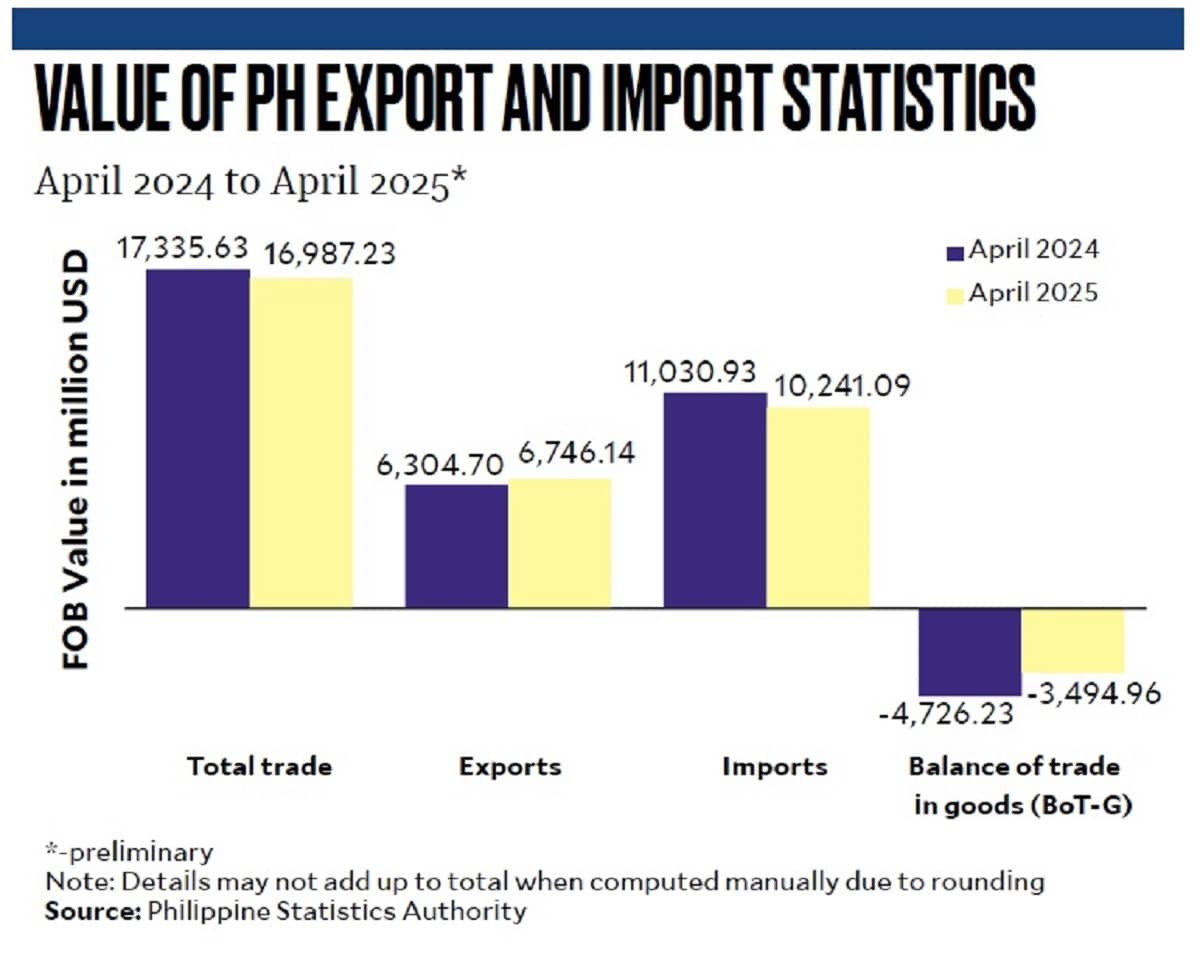
How prominent is the US in our overall economic linkages, especially trade? If we count China and Hong Kong as one country (even though the trade statistics still separate the two), the US has already been dislodged as our largest export market, whose 17-percent share of our exports is now just second to China-Hong Kong’s 23 percent. Contrast this to only 10 years ago, when the US took more than one-third (35 percent), while China-Hong Kong took less than one-twentieth (5 percent). Our vulnerability to a US recession via an export slowdown is therefore far less than what it would have been 10 years ago.
But let’s look more deeply into the details, particularly the destinations of our top exports. Electronic products, which account for two-thirds of all our export earnings, are now well distributed among our top four buyers for these products, with the US taking only 14 percent. China-Hong Kong takes 23 percent, Japan takes 15 percent, Western Europe takes 14 percent, and even Singapore and Malaysia take sizable shares of about 8 percent each. On the other hand, the US takes up the bulk (79 percent) of our garments exports, our second (but a far second) largest export. Mineral exports to the US hardly matter, with most going to our neighbors. Woodcraft and furniture, another top export earner, mostly go to Japan, with only 20 percent going to the US.
Garment workers
Thus, based on merchandise export linkages alone—which is probably the most prominent link through which a US recession will hit our economy—we seem to be sufficiently “decoupled” from the US economy, especially considering that merchandise exports account for only about a third (36 percent) of our total GDP. Among workers in the export industries, then, it would be those in the garments (including footwear) industry who will feel the brunt most, with the impact on the rest of export workers not expected to be as pronounced.
This is still far from the complete picture, though. Next week, we will examine more data to examine other ways a US recession can hit us, including via non-merchandise exports (e.g. call centers), investments, and remittances.
* * *
Comments are welcome at chabito@ateneo.edu