





Enterprise Bank of Mindanao: Microfinance bank in transition
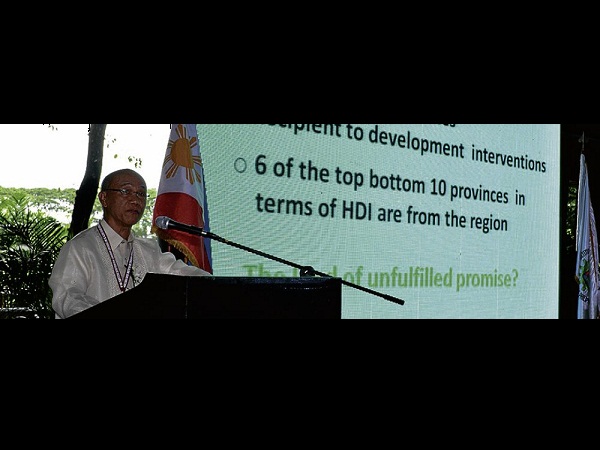
CHITO Alvizo addressing the UP ISSI-Serdef Competitive Entrepreneurial Leadership forum
In 1976, The New Rural Bank of Lianga in Surigao was put up by a native son, Ignacito “Chito” Alvizo, who had a vision to “be an instrument in alleviating poverty in Mindanao” where six of the bottom ten provinces in the country can be found.
By 1994, the rural bank was in dire financial straits owing to mismanagement and poor lending policies, not to mention its participation in some ill-fated government-sponsored agricultural lending programs. Turning his back on his promising career as international small business consultant, Alvizo rehabilitated the bank he founded and transformed it into Enterprise Bank, Inc. (EBI), a “high-breed” rural bank with micro-credit as its centerpiece product.
In time, EBI became the leading micro-finance institution in Mindanao—having grown to 21 branches and 19 micro banking offices and kiosks all over the region, employing a work force of 600 people servicing over 40,000 micro-entrepreneurs, mostly women.
Today, EBI is in transition from a microfinance institution to a thrift bank, gradually shifting from lending to micros to servicing the financing needs of formal small enterprises—those that are more sustainable and capable of innovation, growth, and job-creation.
The 36-year story of EBI’s rise from an almost bankrupt to a dynamic, visionary bank was recounted by Alvizo at the Conference on “Competitive Entrepreneurial Leadership” organized by the UP Institute for Small-Scale Industries (UP ISSI) in cooperation with the Small Enterprises Research and Development Foundation (Serdef) last August 25 to mark the anniversary of the UP ISSI’s founding. Alvizo used to be a small business specialist and head of the information and extension department at the UP ISSI.
Foremost vision:
Inclusive banking
At the outset, he had clear and coherent direction for EBI, Alvizo says. His objective was to build communities, following the principle of financial inclusion. “We wanted to reach the ‘unbankable,’ those outside the normal market segment of banks.” He made sure Enterprise Bank had presence in communities where the incidence of poverty is highest.
The “Kalisod mo, Tabangan ko” (literally, “your hardship. I will lend a hand to”) program became the backbone of EBI’s services to micro-enterprises. Following the now classic Grameen concept, it organized women in the rural communities into celdas and taught them to save until they are qualified to borrow in order to put up or improve income-generating small enterprises. The women attend weekly center (cluster of celdas) meetings, where they discuss and decide matters relating to business management, leadership, loan repayment, repeat loans, and related matters.
Thus the unbanked learned how to bank with EBI—with deposit products designed to fit their financial profile and needs and with access to ATM machines in remote areas, micro-express loans, and of course micro credit. EBI also offers remittance services for families of OFWs, micro-insurance services for low-income entrepreneurs who constantly contend with emergency situations like sickness or death of a family member, and PHC and SSS payment systems.

SOME of the priority agri-enterprises of the EBI’s small business loan program
“Loans are not enough to ensure survival and growth of micro and small enterprises,” Alvizo says. “They also need services to enhance business performance.”
This was the rationale for the Enterprise Development Center (EDC) the EBI recently put up in Davao City, which will provide nonfinancial services to micro and small businesses, such as management capability building and assistance in business planning and installing accounting, inventory and other business systems.
Earlier, EBI established the Kamayo Mindanao Foundation, Inc. (KMFI), which has been providing financial literacy training to the bank’s micro-enterprise clients. Here, they are taught to monitor their cash flow, draw up a budget and stick to it, and realize savings. The Foundation also implements a community health care education project for its clients, the better to make them productive entrepreneurs and responsible borrowers.
EBI is now in 12 provinces in Mindanao and in Talisay City in the Visayas with a loan portfolio that grew from P8 million in 1994 to P1.5 billion by June 30, 2012.
Alvizo has seen how micro and small entrepreneurs become dynamic partners in building communities when provided with capital to improve their business ventures and allow them to participate in formal banking.
Empowering employees
But the empowerment of the smallest of the small businessmen couldn’t have been achieved if EBI didn’t empower its own work force.
This is considered crucial to the attainment of EBI’s vision: The motivation of its own people to be of service to those who are financially disadvantaged. But it didn’t stop with communicating its vision and goals nor with inculcating core values of how it wants products and services to be delivered. “People are motivated to your cause if you set up well-defined structures and systems that create a working environment that in turn brings out the best in people.” Thus, EBI made its employees relate to its vision through capability-building programs and other perks and incentives.
 At the Enterprise Bank, employees are encouraged to take initiatives in product development and service delivery improvement.
In transition
After 36 years as a micro-finance institution, the EBI is ready to raise its mandate to a new level.
Soon, EBI will be a thrift bank.
“We are at a stage where we need to take some of our clients to a much higher degree of enterprise development.”
With the present proliferation of NGOs engaged in micro-finance, EBI is ready to leave its very small clients to other capable hands to focus on supporting those formal enterprises that have the capability to innovate, grow, and absorb the unemployed, and contribute to regional industrialization and development.
Already, EBI has made substantial investments in the food processing sector, including rice mills, agri-produce transport companies, banana plantations, livestock farms.”
“In the next five years, we expect the loans to the formal small business sector to be our flagship product, that will comprise 50 per cent of our total loan portfolio.”
Note: For more how-to-start and how-to-improve your business articles and entrepreneurial success stories, visit the Small Enterprises Research and Development Foundation (Serdef) website at www.serdef.org.


