





Big AIDS meeting’s bottom line: More treatment
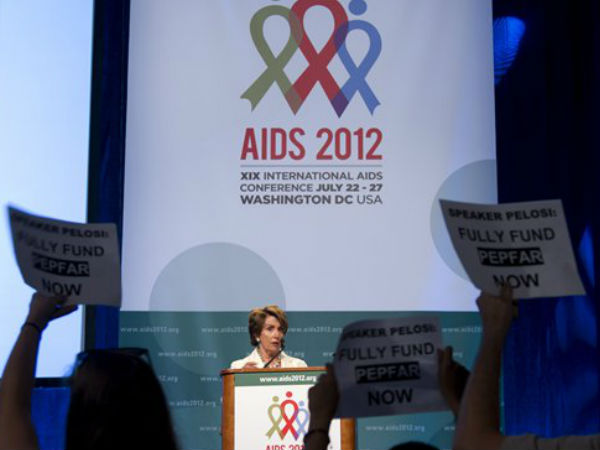
House Minority Leader Nancy Pelosi of Calif. speaks at the 2012 International AIDS Conference, Friday, July 27, 2012, in Washington. (AP Photo/Haraz N. Ghanbari)
WASHINGTON — Call it a triple win for fighting the AIDS epidemic: Treating people with HIV early keeps them healthy, cuts their chances of infecting others, and now research shows it is also a good financial investment.
The International AIDS Conference closed Friday with the message that getting treatment to more of the world’s 34 million people with HIV is key to curbing the epidemic, short of a vaccine and cure that still are years away.
“It is unacceptable” that scientifically proven treatment and prevention tools aren’t reaching people who need them most, Nobel laureate Dr. Francoise Barre-Sinoussi, co-discoverer of the AIDS virus and new president of the International AIDS Society, told the meeting’s closing session.
Former U.S. President Bill Clinton, whose foundation funds HIV work, also addressed the group. “All of you have created the possibility that we could have an AIDS-free generation,” he said. “We just have to keep pushing the rocks up the hill.”
Spreading treatment will be hugely expensive up-front, but Harvard researchers said Friday that the investment would actually save hard-hit South Africa some money over five years, as savings from treating AIDS-related illnesses exceed the medications’ price. Eventually those savings will be overtaken by the costs of treating millions for decades, but treatment-as-prevention still is highly cost-effective, said Dr. Rochelle Walensky of the Harvard Center for AIDS Research.
“People used to think there was no way we can do this,” said Dr. Diane Havlir of the University of California, San Francisco, who co-chaired the world’s largest AIDS meeting. With both scientific and financial validation, “for the first time we’re optimistic that we can.”
But new U.S. data show how hard effective treatment is, even in developed countries. Here, most HIV patients have access to treatment, and guidelines say they all should be offered it right after diagnosis. Yet just one in four have their infections under control, the Centers for Disease Control and Prevention reported Friday. Young people and blacks fare the worst.
“We now need big thinking” to improve that number, said Dr. Kevin Fenton, director of CDC’s AIDS center, who would like to see it at least doubled soon. “We have the tools. Now we have to move them into real-world policy so they touch the lives of those who need them most.”
What to look for next?
—More HIV testing, the first step to knowing who needs treatment. In the U.S., nearly 20 percent of people with HIV don’t know they’re infected. In some countries, less than half do.
“For every $1 we invest in HIV testing, we recoup $2 in societal benefits,” CDC’s Fenton said.
—Debate over how best to use another new protection, giving at-risk healthy people the daily AIDS medicine Truvada to lower their risk of infection. In the U.S., it will cost $14,000, and worry emerged at the conference about whether people who took the pill would forgo mainstay protections like condoms.
—Specialists called for overcoming stigma that is blocking the HIV prevention message from reaching many of the people most at risk, especially gay and bisexual men.
Consider Malawi, where homosexuality is illegal and so AIDS prevention stresses heterosexual risk factors, said Johns Hopkins University researcher Andrea Wirtz. Her team managed to study 338 gay men in Malawi, and most said they’d never heard that HIV can be spread through anal sex and didn’t know how to reduce their risk, she reported Friday.
__A bigger push for women-controlled preventions when their boyfriends or husbands won’t use condoms. Activists asked the U.S. government to send more female condoms to hard-hit poor countries, and research is beginning in Africa on a vaginal ring soaked with a potentially HIV-blocking drug.
—More research to try curing HIV, or to at least put it into remission like cancer, although scientists cautioned that if that is possible, it probably will take 10 years.
—More research into a vaccine, following new clues about a rare kind of antibody that might be able to block HIV from infecting cells.
And the U.S., where patent laws mean HIV treatment costs much more than in poor countries, soon may get a price break. Today, a single daily pill that combines three medications is the first-choice treatment, and costs about $15,000 a year. A generic version of one of those medications, efavirenz, is expected soon.
But to take advantage of it, patients would have to switch to three pills a day, as a combination product won’t be available. Harvard’s Walensky said if everyone taking one pill a day made that switch, the U.S. health system would save $1 billion the first year — but she warned that people might not stick with three pills a day as well as they do with one.


