





Private-sector participation promises progress



MANILA, Philippines — Private-sector participation with governmental processes shows much promise for progress in good governance. There is one condition —government officials should regard the private sector as true partners, not just as subjects who will blindly follow them.
This kind of meaningful progress was demonstrated by the public-private Philippine Council of Agriculture and Fisheries Committee on International Trade. It has four working groups. All are chaired by an elected private sector representative, with an Undersecretary from the Department of Agriculture (DA) as cochair.
READ: 2026 push: Economic agencies take plans to private sector
The working groups are likewise chaired by a private sector representative with an Agriculture Assistant Secretary as cochair. The working groups are shown in the chart. Only one accomplishment per group will be highlighted to show how public-private teamwork in government can show good results.
Antismuggling and border controls
Though very much still has to be done, the fight against smuggling has improved tremendously. Apprehensions of smuggled agricultural products totaled P1.9 billion in 2022 and P1.4 billion in 2023. The committee communicated quarterly and consistently with the Bureau of Customs (BOC).
In June 2024, it met the BOC Commissioner in his office and asked for more anti-agriculture smuggling enforcement. In 2024, antismuggling apprehensions doubled to P2.8 billion.
Last year saw less smuggling, which is our objective because of improved systems. It went down by one-third to P954 million.
Export development, promotion and regulation
With guidance from Secretary Francisco Tiu-Laurel Jr and Undersecretary Philip Young, the committee recommended a wholistic view. It emphasized the export supply chain of production to marketing, with the corresponding organizational support structures.
In 2025, Philippine agriculture exports grew by 22 percent, more than Vietnam’s 14 percent and Thailand’s zero percent.
Trade agreements, negotiations and remedies
The committee helped in achieving the Trump tariff decrease from the initial 17 percent to zero percent for coconut, pineapple and several other agricultural products.
At the negotiation’s start, the committee catalyzed and supported the submission of the only agriculture-related document from the private sector. This was approved by nine organizations.
READ: Jumpstarting economy through private sector
It argued for exemption from the initial Trump tariff because, for agriculture, we already import two and a half times what we export to the United States. Agricultural products are not a reason for the US trade deficit. In addition, we are an important strategic partner.
Monitoring, evaluation and impact assessment
After monitoring three years of DA grant fund releases with 30-percent underutilization and nonutilization—indicating waste and corruption—the committee recommended a required grant checklist.
This successful procedure used by banks was not being done. Showing support and strong political will, the DA’s leadership welcomed this as an effective deterrent to undeserved grants. Upon implementation, three DA regional executive directors lost their jobs because of noncompliance and poor performance.
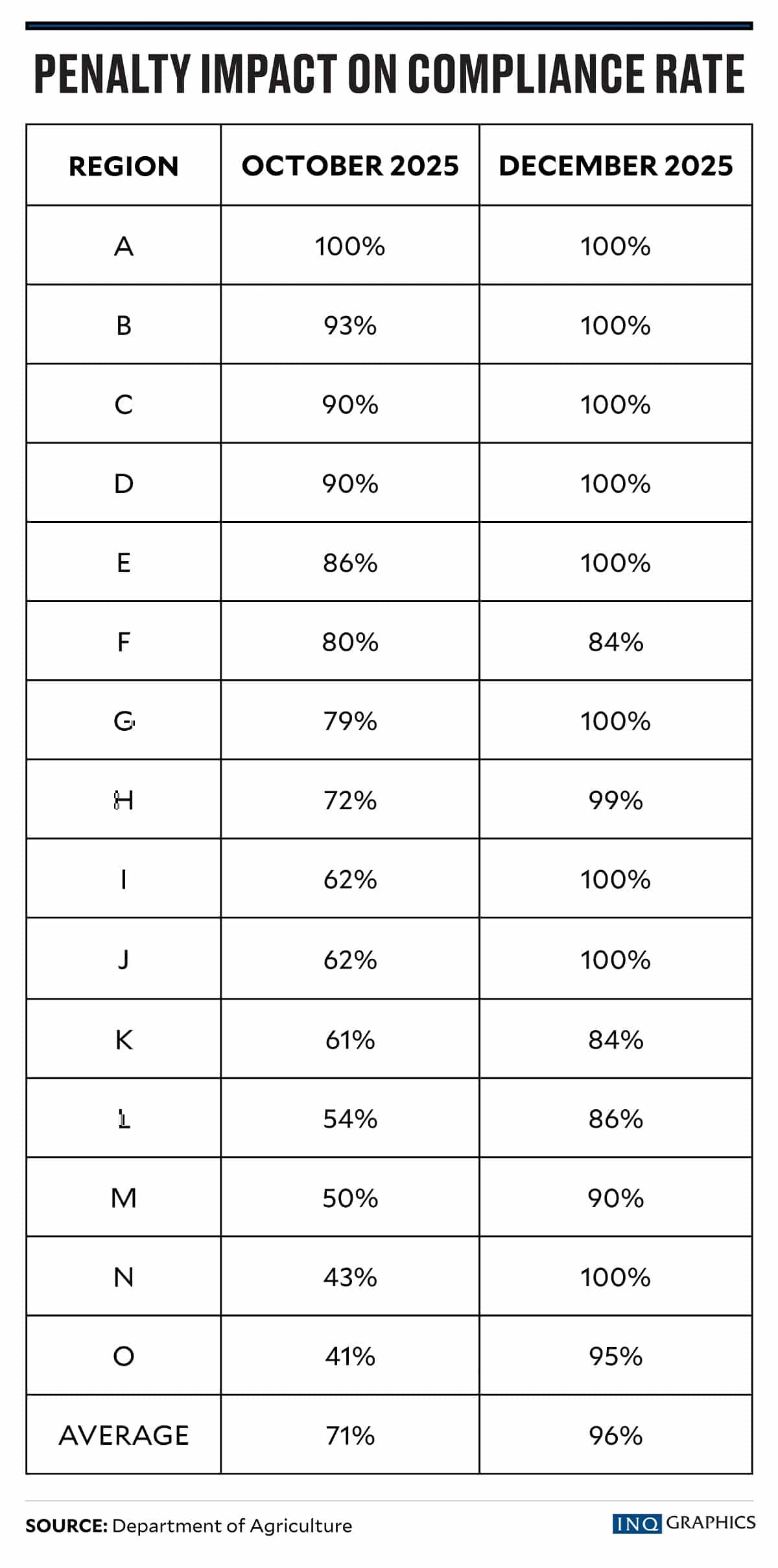
Penalty impact on compliance rate
The chart shows compliance improved significantly after the three regional executive directors lost their jobs. The grant checklist was developed by a joint public- private sector team.
At the start, it did not get the proper attention from the DA regional executive directors, who make the grant decisions. A computerized checklist tracking system was then set up on a monthly transparent basis.
Soon enough, the erring directors were identified and taken out of their jobs. Other directors got the message and immediately complied.
Consequently, the grants will now be responsibly handled. The farmers and fisherfolk will receive more of their needed help, thanks largely to this public-private initiative.
It is this kind of private sector participation, supported by strong government political will, that promises significant progress in good governance. It should be replicated in more government organizations if our nation is to truly develop.
The author is Agriwatch chair, former secretary of presidential flagship programs and projects and former undersecretary of the Department of Agriculture and the Department of Trade and Industry. Contact is [email protected]


