ILLUSTRATION BY KIKO BUENAVENTURA
In strategy, activity is often mistaken for progress. Organizations move quickly to solutions because “doing something” feels productive.
However, in the Problem, Insight, Logic and Assumptions (Pila) reasoning stack, the problem is your structural foundation. If the P is weak, the entire stack—the forced insights, the fragile logic and the risky assumptions—becomes an organizational liability.
Solving the wrong problem well is not just a mistake; it is a catastrophic waste of resources.
The ‘Pipe vs. Bucket’ reality
A real problem is rarely a missed number or a loud complaint. It is a structural weakness, a behavioral pattern, or a silent assumption that quietly creates the conditions for failure.
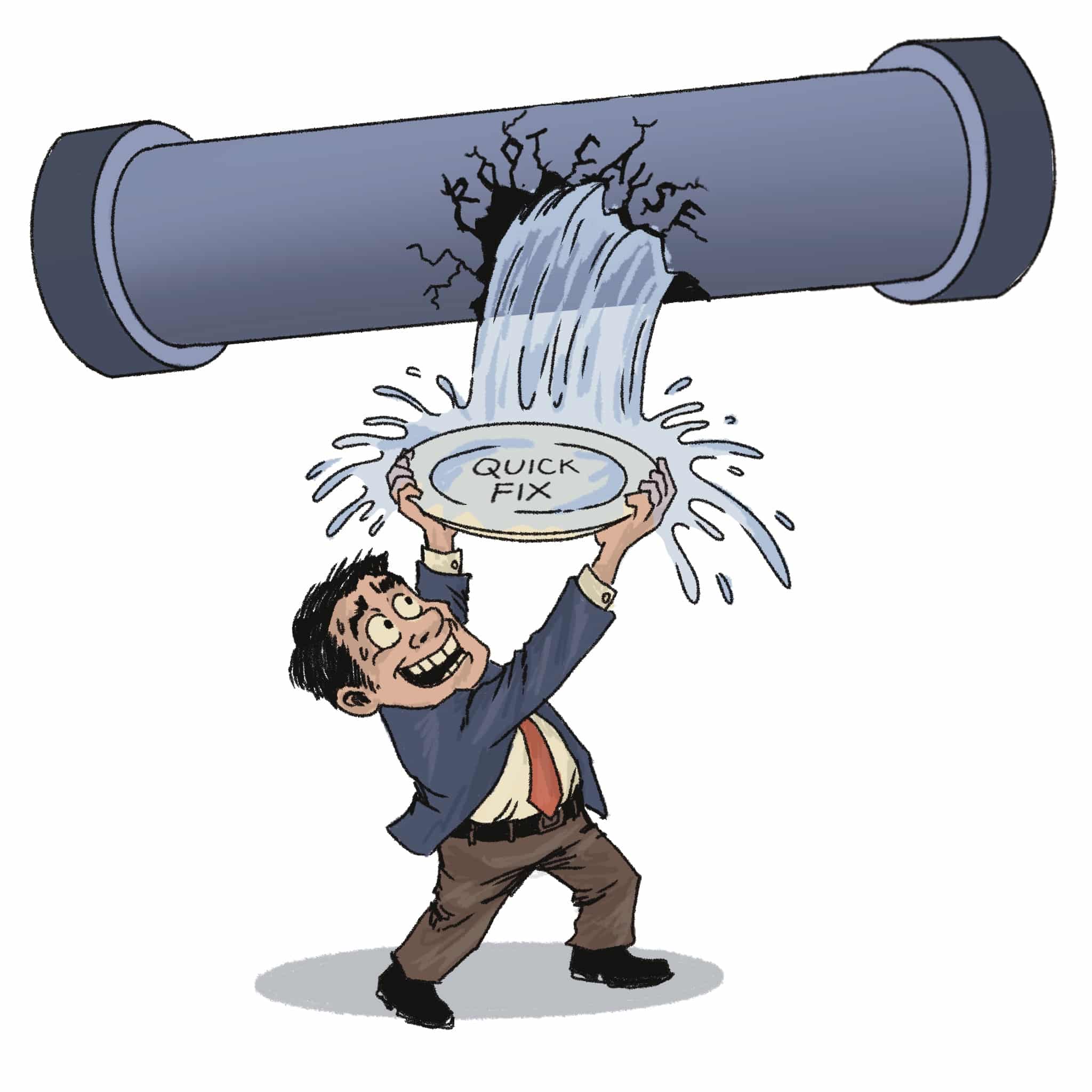
Think of a leak in a ceiling. Placing buckets to catch the drops is containment; fixing the pipe is resolution.
True business excellence begins not in reacting faster, but in preventing smarter. If your organization faces repeated errors and the solution is always “retraining” or “reprimanding,” you are merely putting out fires without understanding why they keep starting.
The architecture of failure: Why teams solve symptoms
Solving symptoms is common because it is predictable and politically safe. Team members often stop at the proximate cause and the immediate trigger rather than digging for the systemic cause. Why?
• Speed pressure: There is urgency to act. Symptoms are visible while root causes take time.
• Solution-inference: The trap of defining a problem by the solution you already want to buy. (e.g., “The problem is we don’t have a new software.)
• The availability heuristic: Defining the problem based on the most recent crisis rather than the most frequent one
• Functional silos: Marketing sees awareness; sales team sees conversion; and operations unit sees capacity. Each is correct but incomplete; the real problem usually cuts across all three.
Sometimes it is deliberate
Not all misdiagnosed problems are accidents. Some are done deliberately to protect incentives, avoid conflict, or preserve budgets.
Real problems often require behavior change, not just more activity. It is easier to fix a symptom than to question a system that requires painful self-reflection. The organization chooses a smaller, “safer” problem, but smaller problems produce smaller results.
The BOLT Framework
To help identify the real problem, you must “BOLT” the analysis. This four-pillar framework serves as both a strategic diagnostic and a rigorous root cause analysis (RCA).
• Behavior: What is breaking? Anchor on what the consumer (or staff) is actually doing, or failing to do, rather than what they say in a survey. If the behavior is unclear, the problem definition is incomplete.
• Origin: The real “why”. Hunt for the systemic source. Move past the first “why.” Dig until you find the point of failure that improves the system as a whole.
•Logic (Interconnection): Connect the dots. Recognize that a problem is rarely a single point of failure. It is a web of interconnected root causes. While traditional tools like the Fishbone diagram list what is wrong (e.g., manpower or machine), BOLT Logic moves beyond mere classification. It explains why those categories are interacting to create a failure (e.g., “Incentive A is driving Behavior B”). BOLT seeks the cause and effect, the hidden narrative of how incentives, culture and processes weave together to create the “mold underneath the paint.”
Tension: What is causing the friction? Identify the specific Barriers, Irritants, Disappointments, and Annoyances (Bida) that create a gap between the current state and the desired outcome. If there is no tension, there is no need for a new strategy.
The governance of problem
A weak P is often a result of a broken Trust Flywheel.
Without humility and transparency, an organization will continue to blame “external factors” while ignoring the “mold underneath the paint.”
We must move toward Double-loop Learning. Single-loop learning (the bucket) asks, “Are we doing things right?” (fixing the symptom). Double-loop learning (the pipe) asks, “Are we doing the right things?” (questioning the underlying logic). It bypasses the immediate urge to act and instead passes the problem through the BOLT Framework to influence the governing variables like the business model and culture.
The ultimate risk is not a missed target, but a logic that no longer matches the market. If the Trust Flywheel is stalled, no amount of ‘bucket-catching’ will save the ship.
BOLT in action: The education case
To see how this works in practice, consider a school facing a crisis: Enrollment is declining.
• Initial reaction (Single loop): The leadership assumes an acquisition problem. They increase the marketing budget to “fill the bucket.”
Applying BOLT (Double-loop).
• Behavior: Data show enrollment numbers are actually stable at the start of the year. However, a significant number of students stop attending by the second semester.
• Origin: The origin isn’t “bad marketing,” it’s a structural misalignment. The course sequence was designed for students with a different high school background, creating a massive knowledge gap. Furthermore, the teaching faculty for these critical foundational years were unimpressive, often the least experienced, leading to poor engagement and low academic morale.
• Logic: The logic and incentive structure of the school prioritized senior faculty for elective ‘specialty’ courses, leaving the foundational ‘make-or-break’ years to those less equipped to bridge the knowledge gap. The ‘mold underneath the paint’ was an internal silo where admissions were rewarded for ‘heads on beds,’ while student affairs lacked the authority to overhaul the uninspiring teaching faculty in year one.
• Tension: Students felt a deep disappointment (Bida) when the “high-touch” promise of the marketing brochure didn’t match the “low-touch” reality of the classroom experience.
• The resolution: The school didn’t need more ads. It needed a student success program. By fixing the retention “pipe,” enrollment stabilized naturally.
Functional shortcuts: Classifying the P
While BOLT provides the depth, functional classification provides the speed. In Marketing, an easy way to narrow down the problem is to classify it into one of four buckets: Awareness, Availability, Acquisition, or Retention. If you diagnose a retention problem as an awareness issue, you will waste millions on ads for a product that people see but simply don’t want to buy.
Quantifying the consequence
A problem without a consequence is not a strategic priority. Before moving to the insight stage of Pila, you must ask: What happens if this is not solved?
• Is there a loss of revenue?
• Is there a reputational risk?
• Is there a regulatory breach?
If the impact is unclear, your P is weak.
Discipline over clarity
In strategy, the mandate is clear: Don’t just solve a problem; own the solution. Most teams aren’t solving problems; they are managing symptoms because it feels productive. It is not.
In the Pila stack, the problem is the filter for everything that follows. If the problem is correct, insights become sharper and logic becomes simpler. Clarity is not the issue; discipline is. You are either driving the market by solving real problems, or you are being driven by symptoms you refuse to diagnose.—Contributed INQ
Josiah Go is a business thought leader, bestselling author of 20 books in marketing and entrepreneurship, and the chair of Mansmith and Fielders Inc. He is the co-creator (with Chiqui Escareal-Go) of the PILA Framework and the Trust Economy Flywheel.