


US tariff on chips puts PH at greater risk compared to neighbors


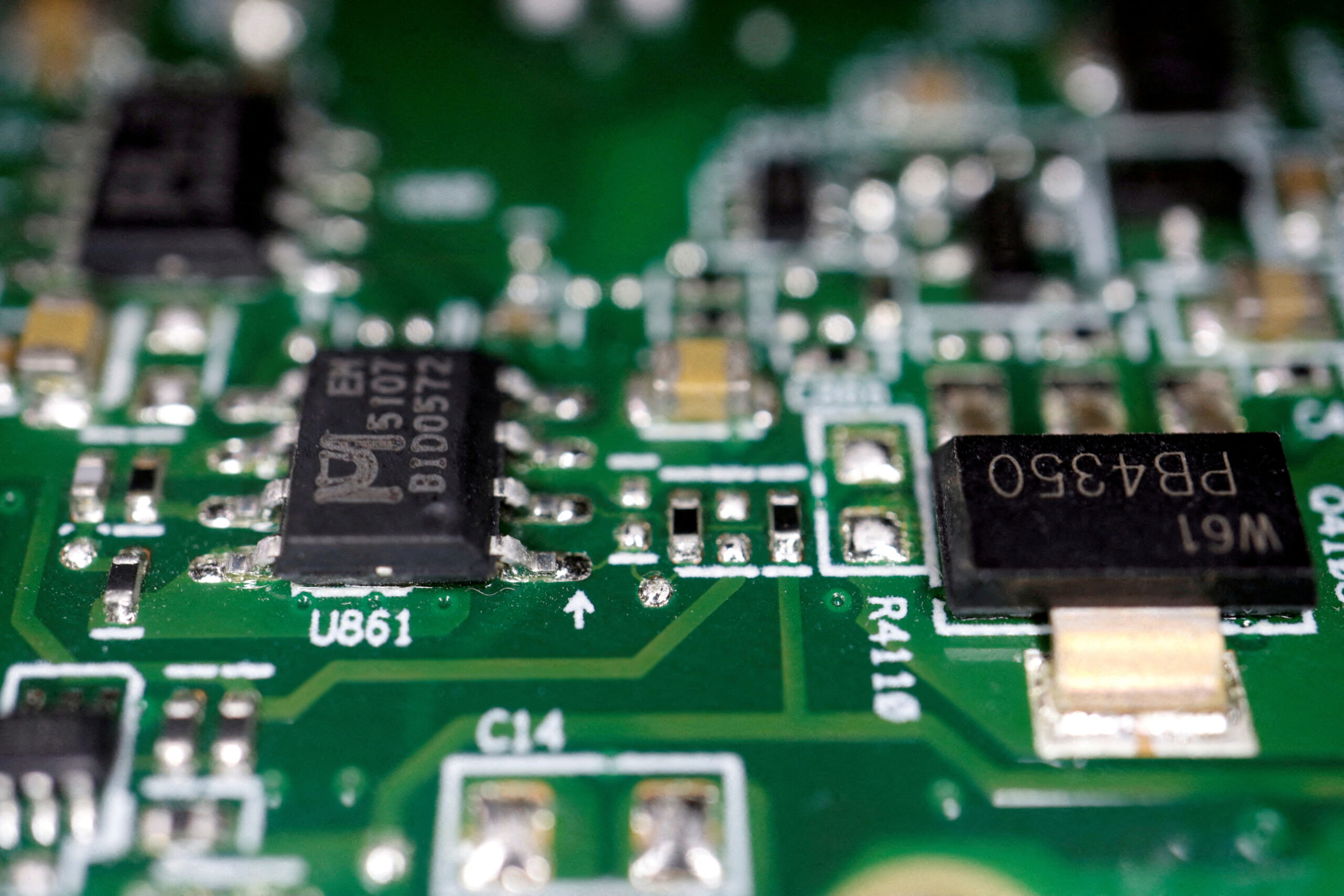
Semiconductors are seen on a printed circuit board in this illustration picture taken February 17, 2023. (REUTERS/Florence Lo/Illustration/File Photo)
MANILA, Philippines — The Philippines faces a greater risk to the tariff policy of the United States compared to some neighboring countries amid the staggering 100-percent tariff on semiconductor exports, according to a former trade undersecretary.
Rafaelita Aldaba, research fellow emeritus at the Philippine Institute for Development Studies, said the country had initially a low risk to America’s reciprocal tariffs announced by US President Donald Trump on several global trade partners in April.
However, following Trump’s recent pronouncement, the Philippines has become more vulnerable to the new US tariffs based on a Tariff Exposure Composite Index (TECI). This measures the vulnerability of the country’s exports to this new tariff regime. Based on the TECI, the Philippines jumped to 2.4 from 1.8 previously.
READ: Is PH the next semiconductor superpower?
But in the case of Vietnam, Thailand and Indonesia, Aldaba said their respective indices were left unchanged.
“And that’s because semiconductors comprise a huge proportion of these two countries’ exports to the US. Hence, that would expose them to a lot of risks given the importance of their semiconductor exports,” said Aldaba.
“The tariff rate severity, the tariff burden, because that’s 100 percent meaning just double the value of the semiconductor exports that you send to the US,” she added.
Electronic products were the country’s top export product. These comprised P39.09 billion or 53.4 percent of total exports of $73.27 billion in 2024, data from the Philippine Statistics Authority (PSA) showed.
Meanwhile, the PSA noted that the US was the leading destination of Philippine exports in the past year. It accounted for 16.6 percent or $12.14 billion of total export receipts.
Manila seeks clarification
Frederick Go, Special Assistant to the President for Investment and Economic Affairs, said earlier the government was seeking clarification from the US Trade Representative (USTR) on whether locally manufactured chips were indeed subject to the tariff.
If imposed, the new import tax would cover a wide range of products—including smartphones, appliances, computers and video game consoles. These were initially part of the US tariff exemption list.
READ: Exemption of Philippine semiconductors from 100% US tariffs pushed
Aldaba said there are opportunities for the Philippines to unlock more opportunities in the global trade market. For example, pursuing industrial upgrading and strengthening the resilience of export products.
She said the Philippines should transition from an assembly-centric to more upstream activities, such as for semiconductors. The country should also expand into other products, as the country remains heavily concentrated in semiconductor and electronics exports.
“We’re doing this already, but it’s really on the more basic, the more simple processes, and what we want is to be able to move up to the more complex stages in the value chain of the semiconductor industry,” said Aldaba.
Further, Aldaba recommended providing subsidies and strategic support for priority sectors as well as reskilling and upscaling of the workers. /rwd


