
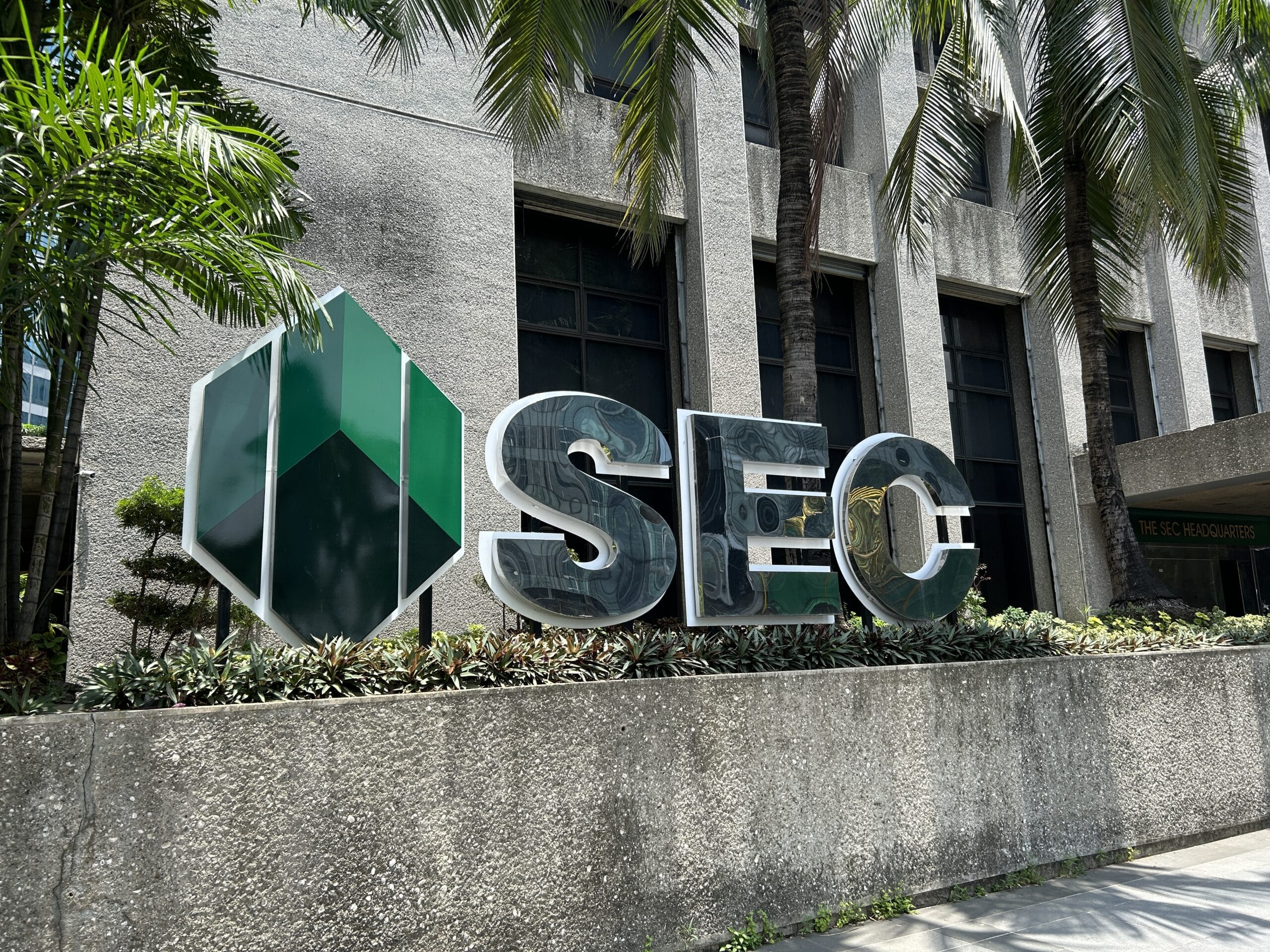
Securities and Exchange Commission (SEC) headquarters in Makati. | PHOTO: Daniella Agacer / INQUIRER.net
MANILA, Philippines — The Securities and Exchange Commission has ordered listed companies to remove the A and B classification of common shares. The SEC cited pricing disparities and administrative inefficiencies.
Under SEC rules issued in 1973, Class A shares can only be issued to Filipino citizens. Class B shares may be issued to both Filipinos and foreigners.
The rule was imposed to ensure strict compliance with the 40-percent foreign ownership limit.
READ: 2 ex-justices air views on 100-percent foreign ownership
However, the SEC argued that the rules resulted in “unfair disparity” between the two classes. Thus. the Aug. 7 directive under Memorandum Circular No. 10, Series of 2025 to stop classifying common shares.
“Such classification has also been the source of administrative inefficiencies for trading participants and the Securities Clearing Corporation of the Philippines,” the SEC said in a statement on Friday.
The regulator also pointed out that technological advancements in the local bourse already enabled strict monitoring and enforcement of foreign ownership limits. This rendered the classification obsolete.
READ: Jollibee opens up stock ownership to more foreign investors
Juan Paolo Colet, managing director at investment bank China Bank Capital Corp., said the mandatory phaseout was “warranted,” especially since the classification had not served “any practical purpose.”
‘Beneficial to the stock market’
“The declassification will be beneficial to the stock market. It will simplify investing in a company’s common shares because there will be just a single class of common stock to trade,” Colet told the Inquirer.
“Companies that will shift to the single classification could also see improved liquidity for their common shares as all trades will be consolidated in a single class of stock,” he added.
Listed firms with Class A and B shares are required to amend their articles of incorporation (AOI) within one year to reflect the order.
“In the event that a trade resulted in a breach of allowable foreign ownership limits, the foreign buyer, through its broker, shall immediately dispose the excessive shares, as soon as practicable, upon discovery of the breach at the prevailing market price,” the SEC noted.
/rwd