





Philippine agricultural trade deficit narrows in April


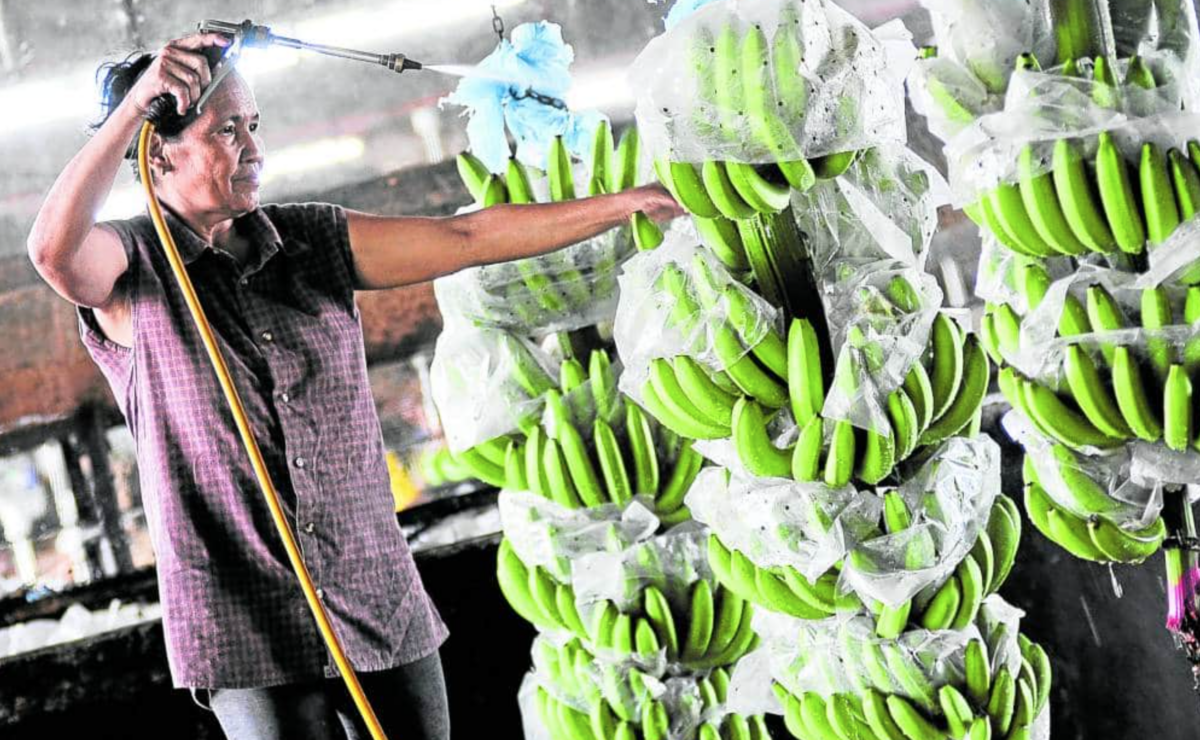
BANANA EXPORTATION / MARCH 17, 2011 A woman washes the harvest banana from the farm to their plantation as they process it for packaging at the private company banana plantation in Tagum City, Davao Del Norte. PHOTO BY: ANDREW TADALAN / PDI PHOTO
MANILA, Philippines — The country’s agricultural trade deficit narrowed in April as exports outpaced imports despite challenges fueled by the tariff war between the United States and China.
In a report, the Philippine Statistics Authority (PSA) said the difference between farm imports and exports had totaled $859.04 million in April, a 12 percent decrease from $976.55 million in the same period a year ago.
The statistics agency said agricultural exports had climbed by 8.7 percent to $743.22 million in April. On the other hand, agricultural imports amounted to $1.6 billion, a decrease of 3.5 percent.
This brought overall agricultural trade to $2.35 billion, a meager increase from $2.34 billion.
“Exports grew twice as much as imports and this is great for Philippine agriculture. At least the latest PSA report shows that Philippine exports can become less dependent on imports,” Roy Kempis, director of Center for Business Innovation at Angeles University Foundation, said in a Viber message.
READ: US agri exports seen growing as Philippines’ middle class expands
Although the export growth rate was positive news, Kempis said the country “must not lose sight” and should explore new markets for locally-produced farm goods.
Kempis said the government should seize more opportunities to boost exports of agricultural products to other nations, particularly the United States and European Union.
Raising market share
He said government officials should increase the export market share in the US now that the latter was looking for alternative suppliers because of the reduced export volumes from China and Association of Southeast Asian Nations (Asean) countries.
READ: To help reduce poverty, export more agri products
“I believe the Philippines should do more to open new markets to increase this, as China has still been a challenge to Philippine agricultural exports. And this is more challenging now amidst the slowing down of the Chinese economy brought about by several factors including the tariff ‘war’ between the US and China,” he added.
Animal, vegetable, or microbial fats and oils and their cleavage products; prepared edible fats; and animal or vegetable waxes comprised 34.5 percent or $256.47 million of the total agricultural exports.
Agricultural exports to Asean nations stood at $47.90 million, with Malaysia as the leading buyer of local agricultural products.
Exports to the EU reached $155.82 million. The Netherlands topped the list of the leading destination of farm goods among European countries.
READ: Philippine mangoes make historic debut in Italy
Cereals, meanwhile, cornered the largest share in agricultural imports with $356.63 million or 22.3 percent.
Farm imports from Asean member nations totaled $693.46 million. Vietnam was the leading supplier of agricultural products.
EU nations supplied $133.50 million worth of farm products to the archipelago, mostly coming from Spain.


