





Asia-Pacific to launch talks on giant free trade zone
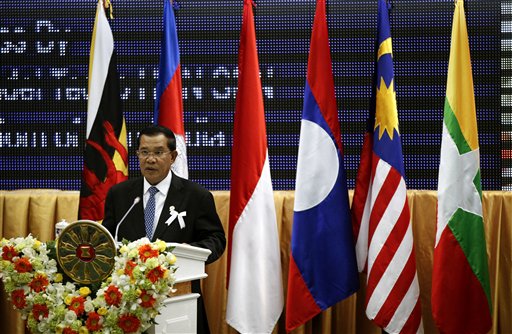
Cambodia’s Prime Minister Hun Sen delivers his opening remarks for the 21st Association of Southeast Asian Nations Summit in Phnom Penh, Cambodia, Sunday, Nov. 18, 2012. Hun Sen will launch the start of negotiations for the Regional Comprehensive Economic Partnership (RCEP) on Tuesday in Phnom Penh on the final day of a regional summit. AP PHOTO/VINCENT THIAN
PHNOM PENH, Cambodia—Southeast Asian nations will launch talks this week for a giant free trade pact with China, Japan, India and other neighbors aimed at easing the region’s reliance on the struggling West.
The planned zone would span across 16 countries of the Asia-Pacific that currently account for a third of global trade and economic output, making it the biggest free trade area outside the World Trade Organization.
Rajiv Biswas, Asia-Pacific chief economist at IHS Global Insight, described the initiative as strategically very important to the Asia-Pacific as it would help offset weaknesses in the United States and the European Union.
“Fast growth in trade within the Asia-Pacific region could significantly mitigate the weak growth prospects in Asia’s traditional growth markets in the EU and US,” he told AFP.
“The (pact) could provide the framework for accelerating regional trade and investment flows, reducing the dependence of East Asia on the traditional EU and US export markets and boosting trade among Asian developing countries.”
Cambodian Prime Minister Hun Sen will launch the start of negotiations for the Regional Comprehensive Economic Partnership (RCEP) on Tuesday in Phnom Penh on the final day of a regional summit.
The RCEP would bring together the 10 members of the Association of Southeast Asian Nations with China, India, Japan, South Korea, Australia and New Zealand.
Asean secretary-general Surin Pitsuwan said a successful RCEP would further cement a shift in global economic power from the West toward Asia.
“The trend is already here. It’s how to consolidate. This one is going to be a big leap forward if we can make it,” he told AFP in an interview on Sunday on the sidelines of an Asean leaders’ summit.
Diplomats and analysts said the RCEP could also serve as a “counterbalance” to the Trans-Pacific Partnership (TPP), another planned free-trade grouping currently being negotiated by the United States and 10 other countries.
US officials hope that the TPP will eventually snowball into a free trade area of the Asia-Pacific that will link economies spanning Latin America and Asia via the United States.
But in one significant difference, the TPP excludes China while the world’s second-biggest economy is foreseen as being a major player in the RCEP.
China has been reluctant to join the TPP, preferring to focus on a free-trade arrangement centred in Asia where it has a bigger influence.
“You can read between the lines,” a Southeast Asian diplomat told AFP in regards to China focusing on a free trade pact that does not include the United States.
Indonesia, Southeast Asia’s biggest economy, said it was only interested at this point in the China-dominated pact.
“We’re only going to be focused on the RCEP,” Indonesian Trade Minister Gita Wirjawan told reporters in Phnom Penh.
There are some concerns that a raft of maritime territorial disputes between the major players in the proposed RCEP could hinder the negotiations.
Diplomatic and trade between Japan and China have been severely shaken this year amid an escalating dispute over islands in the East China Sea.
Japan and South Korea have been locked in a similar dispute over different islands, while China and some Asean members have also seen tensions soar over competing claims to the South China Sea, which Filipinos call West Philippine Sea.
But Surin said the disputes could be managed separately, and that the trend toward closer economic and trade ties could not be stopped.
“The effort is to try to isolate the two issues… economic cooperation, community building in East Asia will have to go forward because everybody is going to benefit from this new architecture,” he said.
Surin said the RCEP had a head start compared with the TPP because Asean already had existing free trade pacts with China, India, Japan, South Korea Australia and New Zealand to build on.
Nevertheless, there has been no timeframe set for when the pact should be finalized.


