
Quantcast
Latest Stories

Philippines scores low in infrastructure in WEF competitiveness ranking—DPWH
By

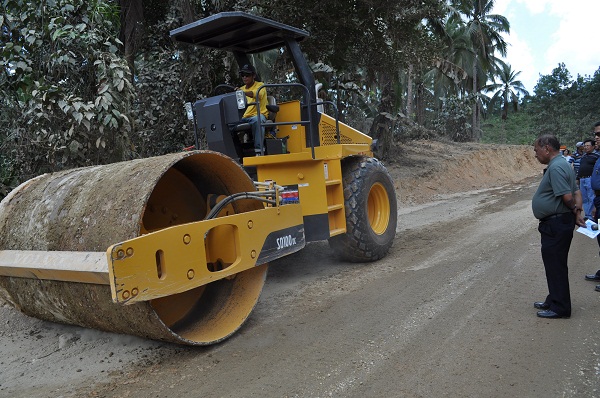
A government road project in El Nido in Palawan. The Philippines ranked a “mediocre 113th” for the overall state of its public infrastructure, with particularly low marks for the quality of its seaports and airports, in the 2012 Global Competitiveness Report of the World Economic Forum, according to the Department of Public Works and Highways. PHOTO FROM DPWH.GOV.PH

MANILA, Philippines—On a scale of 1 to 7—with 1 being extremely underdeveloped and 7 extensive and efficient by global standards—roads in the Philippines scored a low 3.1 in the 2012 Global Competitiveness Report of the World Economic Forum, according to the Department of Public Works and Highways.

In a DPWH report furnished the Philippine Daily Inquirer, the agency also disclosed that out of the 139 countries worldwide, the Philippines ranked a “mediocre 113th” for the overall state of its public infrastructure, with particularly low marks for the quality of its seaports and airports.

Except for Vietnam, which scored a much lower 2.6, other countries in the region garnered the following scores on the quality of their roads: Singapore, 6.5; Hong Kong, 6.2; South Korea and Japan, both 5.8; Malaysia, 5.7; Taiwan, 5.6; Thailand, 5; China, 4.4; Indonesia, 3.5; and India, 3.4.

The DPWH pointed out that “the Philippines is lagging behind its neighbors in the Association of Southeast Asian Nations in terms of quality infrastructure and in particular, the quality of roads.”

“Although there has been an improvement from the 2010-2011 Global Competitiveness report, the Philippines is still behind except for Vietnam, which may not be for long due to heavy investments in infrastructure going on in that country,” it said.

With public investments of nearly P700 billion, the DPWH has expressed confidence the Philippines’ ranking would improve before the end of President Aquino’s term in June 2016.

“Of the total investment requirement of P698 billion, at least P585.93 billion is earmarked for the highways sector (from 2011 to 2016),” said the DPWH report.

From P75.04 billion in 2011, the agency is spending another P81.2 billion this year on national roads, followed by P91.7 billion in 2013, P101.3 billion in 2014, P113.7 billion in 2015 and P122.9 in 2016.

Public Works Secretary Rogelio Singson has called upgrading the quality and safety of national road infrastructure in the country as “one of the DPWH priorities.”

According to Singson, “the national road network is the most important infrastructure asset of the government.”

“An indicative estimate of the national road network asset is valued at P1.2 trillion. The road network provides the connectivity to all Filipinos for their economic and social activities. As such, the President has directed DPWH to ensure that the quality and safety of our national road network are upgraded and maintained properly. DPWH funding for our national roads and bridges is being increased substantially to ensure continued economic growth nationwide,” he noted.

Budgetary support until 2016 has been intended to achieve the DPWH’s key targets, said Singson.

The DPWH aims to “pave by 2014 all existing unpaved roads out of the 15,872 kilometers of national arterial roads, and by 2016, pave all existing unpaved roads out of the 15,370 kilometers of national secondary roads.”

National arterial roads refer to the “main trunkline from northern Luzon to southern Mindanao, interconnecting major islands,” while national secondary roads are “other roads complementing national arterial roads that also provide access to main population centers.”

In the same report, the DPWH said the government would look at Malaysia “as a benchmark in terms of quality of roads.”  With a road network of over 98,720 kilometers, 1,821 km of which are expressways, the Asean country’s infrastructure is one of the most developed in the region.

Its longest highway, the North-South Expressway in Peninsular Malaysia, extends over 800 km, linking the Thai and Singaporean borders.

The DPWH also aims to “make all bridges on national roads of permanent structure by 2016.”

By the same year, the department also targets the following: rehabilitation of 58,592 meters of national bridges; widening of 12,236 meters of existing bridges; construction of 18,255 meters of new bridges; and replacement of 19,725 meters of damaged bridges.

On upgrading the quality of national roads and bridges, the DPWH’s policies and programs include the “adoption of new standards for concrete pavement thickness from 230 mm to 280 mm, outsourcing project inspection and quality assurance, developing new construction design standards and specifications, and strengthening or retrofitting of bridges to comply with international seismic standards.”

On improving road safety, the agency has been “constructing loading and unloading bays, using Traffic Accident Recording and Analysis System and the International Road Assessment Program, assessing 2,500 km of national roads that are considered as ‘high risk’ roads, enforcing anti-overloading provisions of the law, and clearing of road hazards, illegal structures and obstructions along national roads.”


Follow Us


Follow us on Facebook Follow on Twitter Follow on Twitter


Recent Stories:

Complete stories on our Digital Edition newsstand for tablets, netbooks and mobile phones; 14-issue free trial. About to step out? Get breaking alerts on your mobile.phone. Text ON INQ BREAKING to 4467, for Globe, Smart and Sun subscribers in the Philippines.

Short URL: http://business.inquirer.net/?p=81138

Tags: 2012 Global Competitiveness Report , Business , Department of Public Works and Highways , Global Nation , Philippines , public infrastructure , roads , Rogelio Singson , world economic forum

  • http://twitter.com/MarLouWang Marlou Wang

    kickback! kickback! kickback! papaano ba maaayos ang roads natin UUNAHIN MUNA NG MGA ENGINEERS AYUSIN ANG MANSION NILA! TAPOS WALA PANG TATLONG BUWAN SIRA NA ANG ROAD NA GINAWA, ANOTHER GASTOS NA NAMAN! GANYAN ANG CYCLE NG INFRASTRUCTURE SA ATIN. KICKBACK-ORIENTED!

  • http://pulse.yahoo.com/_SUFWFR5WH6IKBXGMOOSQFXLSP4 Boy Scout

    kailangan ma centralize ang infrastructure at mga projects ng pilipinas, ang kick back ng mga buhaya sa isang projects 35% ng total cost ( dating 15%)  isa akong civil enhinyero dito sa pinas pero kayang kaya baguhin ang design at proposals mo ng “alalay” ng mga buhayang pulitiko para sa sarili nilang kapakanan.

  • rodben

    noong 70′s ginawa ang kalsada sa aming bayan sa Bicol hanggang ngayon maganda parin, Yong mga bagong kalsadang gawa maihian lang ng kalabaw pitak na.NOONG 70′s PINAS ang may pinaka modernong airport sa ASEAN pero ngayon tyo na ang may pinaka bulok na airport sa ASEAN utang ng gobyerno umabot na sa 7trillion pero palaging wala daw pera sa infrastractura inaasahan mga negosyante kya naman lahat ng kalakal kontrolado ng mga ito anytime pwede mag taas. ANG PINOY NGA NAMAN, pero bakit kya walang investigation sa DPWH ngayon? KAILAN KYA MATITIKMAN MULI ANG DATING SIGLA NG PINOY? GOD BLESS TO ALL

  • http://profile.yahoo.com/VUFRGRCCA5JXOLKEVCJQ3FBW3Y Concerned Citizen

    Maybe we can learn a lot from the  US about roads.  They are very efficient in this such that re-asphalt of roads is done only by 1 person who even puts the necessary road warning signs.  In Metro Manila, the same job is done by a lot of workers who are mostly spectators also. Contractors seem to pocket very big profit margins to allow such inefficiencies. Other cost efficient savings that result to longer roads for the same budgets are in the application of new technologies where synthetic plastic wastes become part of a stronger concrete mixture.  Maybe DPWH should study their practices and impart what they learn to its contractors.  Such will benefit us in both quantity and quality of infrastructure.

    DPWH can lower bids if it improves its payment performance. A lot of government contractors double their bids because of this problem. This is a seed of corruption in the system. If this problem is addressed, government will become a step higher in its maturity level.

  • http://pulse.yahoo.com/_Q6I2R3ZB2OXDBYC3C6FRMPBQBU Murphy

    Hindi nakakapagtaka kung kulelat tayo eh DPWH sang damakmak ang kurakutan dyan. Ang masakit lang kasi ung ayos na mga kalsada binubungkal at ni-rerepair pero ung mga talagang sira pinapabayaan lang, baligtad ata, di dahil kaya sa baligtad din utak ng mga taga DPWH?

    • Wadav

      tama ka Murphy, yan ang malaking problema natin. sinira nila ung di sira kc meron kikita pag ginawa nla yon. this kind of practice will never go away! DPWH is really a rotten dept. at alam natin lahat yan! 

  • renato_dangal

    sa makati maski di sira ang roads sinisira…anu ba yan? ang daming nangangailangan kumpunihin…

  • mark1205

    What the DPWH should consider also is the appropriate wideness of all roads to cater a long-period projection. We spend BILLIONS in road widening because no one saw 20 years ago of the ever increasing demand of vehicle traffic. ALSO: WIDEN OUR SIDEWALKS! 1-2 meters is not enough! We need wider in urban cores to encourage walking. PLUS FACTOR WOULD BE TREES!


Copyright © 2013, .
To subscribe to the Philippine Daily Inquirer newspaper in the Philippines, call +63 2 896-6000 for Metro Manila and Metro Cebu or email your subscription request here.
Factual errors? Contact the Philippine Daily Inquirer's day desk. Believe this article violates journalistic ethics? Contact the Inquirer's Reader's Advocate. Or write The Readers' Advocate:
c/o Philippine Daily Inquirer Chino Roces Avenue corner Yague and Mascardo Streets, Makati City, Metro Manila, Philippines Or fax nos. +63 2 8974793 to 94
Advertisement

News

  • PSG men ‘bemedaled’ prior to QC rob raps
  • PH lits up Guinness for most sky lanterns flown simultaneously
  • China cordon drives fishers inland
  • DOH bats for ‘SEX’ in call centers
  • Polls solidify LP hold in most of Visayas
  • Sports

  • GM Paragua shares Asian chess top spot with Li
  • Dazed Beermen try to get back at Thais today
  • Sportswatch
  • Catalan, Lim lead Jr Masters champs
  • All-Japan stint for karter Cabrera
  • Lifestyle

  • Call center workers told to have more ‘sex’ in their lives
  • Imperial and ‘monarchic’ scent–it could only be French
  • ‘Asian fit’ menswear by way of Savile Row
  • Punk meets history in first Chanel show in Asia
  • Wild cinnamon bark tea, berry wine, coco sugar brownies–Hindy Tantoco’s ‘Balik Bukid’ buys
  • Entertainment

  • Demi Lovato is a work in progress
  • Stars’ ‘shameful’ secrets revealed
  • Penchant for loopy and messy details
  • Nora and Vilma go indie
  • Three inspiring real-life dramas at the polls
  • Business

  • GDP on track to meet 6-7% target
  • Stocks continue to decline
  • BSP chief says capital flight to spare PH
  • Imports contracted in Q1
  • MBC, FPI buck halt to oil smuggling case vs Phoenix
  • Technology

  • Yahoo takes big leap with $1.1B deal for Tumblr
  • Poll: More US teens turn to Twitter; Facebook old
  • Tips to avoid becoming an identity theft victim
  • Filipinos in flight want to go online
  • SMC pledges to put more capital in Liberty Telecom
  • Opinion

  • Brillantes’ tantrums
  • Pointed questions for the Comelec chair
  • Social enterprise as innovative business model
  • Perennial irony
  • Voters like election surveys
  • Global Nation

  • Lapid’s wife back in PH after US probation for cash smuggling—immigration exec
  • Russian’s Mayon caper cost gov’t P520 K
  • 2 former sex slaves cancel Japan mayor meeting
  • Brown hounded for calling Manila ‘gates of hell’
  • PH, Taiwan seen to start talks on fishery agreement by June
  • Marketplace
    Advertisement
    © Copyright 1997-2013 INQUIRER.net | All Rights Reserved
    skinner left
    skinner right