
Quantcast
Latest Stories

Bad habits, overdevelopment caused Metro floods, say analysts

By

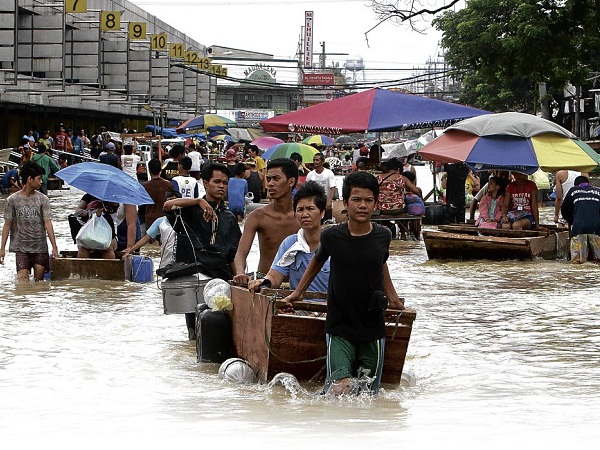
This time, real estate analysts agree with the views of a nature conservationist. Jose Ma. Lorenzo Tan, chief executive officer of the environmental group Worldwide Fund for Nature (WWF)-Philippines, was quoted by the Inquirer last August 13 as saying, “Filipinos, not the monsoon rains, are to blame for the deluge that paralyzed the metropolitan area of 14-million residents last week.” The Inquirer article also cited Tan as saying that “the latest disaster to hit the Philippines was a result of an unfettered and mindless march to urbanization that had replaced soils and trees, which could absorb the rains and reduce flooding, with concrete jungles.”

Veteran real estate broker Enrico S. Cruz, a civil engineer who resides in Marikina, said he “fully agrees” with Tan’s observations, but said this would be just “one of several factors causing these disasters.”

“For example, more building and developments result in less trees and open spaces, which result in more rainwater in the surface that needs to flow to the existing outdated drainage system that gets clogged because of improper waste disposal, or sometimes intentionally clogged by the enterprising neighborhood making a few pesos pushing cars out of their intentionally flooded streets.”

Enrique M. Soriano III, Ateneo program director for real estate and senior adviser for Wong+Bernstein Business Advisory, said, “The subject of overdevelopment is now classified as a ‘clear and present danger’ and must no longer be ignored.”

Overdevelopment

Soriano said: “We can no longer hide an elephant in the room! Overdevelopment overwhelms the natural resources of a given area. In Metro Manila and the expanded NCR, with a population base of close to 17 million, overdevelopment is the fastest-growing threat to our local environment that will inevitably impact our quality of life.”

He added: “As property stakeholders, are we providing a reasonable and concerted support to make every development, every zone compliant to environmental standards? The consequences of decades of unplanned, rapid growth and poor land-use management are evident: increased traffic congestion, crowded schools, worsening air and water pollution, disappearing open space, increased flooding, wildlife habitat destroyed (whatever of that has been left in the Metro), higher taxes and deteriorating city centers.”

Julius Guevara, Colliers International’s associate director for valuation and advisory services and head of consultancy and research, said: “While some real estate developers have again been put in a bad light, I think that some sectors have unfairly put the blame on this sector. Bad urban planning and management is the culprit, and real estate developers wouldn’t build on a site if they didn’t get the permits. How they got those permits is another story altogether, though.”

Guevara explained that “the effects of climate change, whether caused by man or nature, are apparent in the spate of flooding that we are experiencing. Real estate development should be more responsible.” Guevara suggested that one way to do this is to inject green building strategies into the development. He explained that stormwater management strategies can be employed, such as building retention and detention ponds to control rainwater onsite before it goes to the public stormwater systems. These ponds and bioswales can be installed in horizontal developments to act as amenities as well as effective stormwater control.

“One may notice that it floods in the metro right away even when it doesn’t seem to rain that much. This is because there is too much impervious material on our ground, such as concrete and asphalt. Minimizing these impervious surfaces is essential; porous paving blocks can be substituted so that water can be absorbed by the soil underneath,” Guevara said.

Obsolete dev’t patterns

Soriano suggested that the government and stakeholders must now rethink and rewrite development patterns that are obsolete, with some dating back to the end of World War II. The Housing and Urban Development Coordinating Council (HUDCC) must now compel developers to disperse developmental programs outside Metro Manila and encourage “smart growth initiatives” in city centers compromised by overdevelopment. Government must now seriously “walk the talk” on issues related to urban development, less vehicle-dependent master plans and draconian programs in the enforcement of zoning and homebuilding laws.

Cruz added that even with a good drainage system, the water needs to flow to the creeks or natural waterways which is silted because of indiscriminate waste dumping and narrower (drainage system) because of illegal settlement and illegal encroachment or reclamation.

“But please look at the mountains. Less trees because of logging, legal or illegal, subdivision developments, and mining. Because of less trees in the mountains, more water comes down to the rivers. Coming down with the water are mountain soils and waste that will contribute to the siltation and clogging of the riverways,” Cruz said.

He urged readers to see the extent of “these causes” by opening Google Maps.

“In the Manggahan Floodway, for example, a closer look will show settlements in the apron of the man-made canal. A closer look will show further that there are kangkong plantations that may seem innocent, but during critical flooding situation, their being in the waterway adds to the problem by impeding waterflow.”

In civil engineering terms, an apron is “any device for protecting a surface of earth from the action of moving water, a platform to receive the water falling over a dam.”

(Analysts offer more solutions next week.)


Follow Us


Follow us on Facebook Follow on Twitter Follow on Twitter


Recent Stories:

Complete stories on our Digital Edition newsstand for tablets, netbooks and mobile phones; 14-issue free trial. About to step out? Get breaking alerts on your mobile.phone. Text ON INQ BREAKING to 4467, for Globe, Smart and Sun subscribers in the Philippines.

Short URL: http://business.inquirer.net/?p=77498

Tags: Environmental Issues , floods , Metro Manila , Philippines , property

  • branlem

    yes all true and quite a long list of things to do isnt it…shall we start working?   we got less 3 years before another ondoy comes ready to devastate our city….as citizens can we start working on our existing drainages?   lets not wait until our government starts doing anything…we can do our share…

  • http://www.facebook.com/red.rodriguez.50 Red Rodriguez

    I Absolutely agree with these finding and analysis of repid development that resulted in overdeveloped of open space by realty develops. Site an example of a birmingham subdiividion in antipolo city, somewhere in the middle of phase 1 n phase 2, a creek was reduced in size and ironically transformed into box culvert of which the size is less capacity to carry the huge volume of water. The creek that cross a bridge along national road also reclaimed by a lot owner of the other side until the proprty line of birmingham. Though installing a 6 x 60diameter conc. pipe to maintain the water flow the water somehow was stalled at the foot of the brifge thus decreasing the current of the water. Wnn homeowners verify at the municipal office of antipolo city they found out that it has the required permit.

  • JiyoonMin

    Pass the RH bill, overpopulation is a major conduits on what’s happening right now beside climate change.

    • Savy

      Yes, pass the RH bill.

      • GungGung

        Oh, the RH bill.. Reconstruction and Housing bill that helps build low-cost houses for the homeless.

    • http://www.facebook.com/patrick.dimaculangan.9 Dimaculangan Patrick

      Metro Manila is not overpopulated, overcrowded is a better term…

      Population control is not the solution, efficient and sustainable planning is.
      Trust me, Im an Architecture student and we studied about that. the major cause of flooding is already stated above. If green building planning is implemented, you can have agriculture in the middle of the city…. on the roof top. Plus population control will not bring any good for the country, only demographic winter

      • http://pulse.yahoo.com/_GNF53M5MOUXUDELOFJYK7H3CCU Melchor

        Please explain what is efficient and sustainable planning? I dont think having agriculture on the rooftop will solve flooding in Manila..but I would like to know your idea on how this will solve the problem of flooding before I trust you as you have stated above.. also, what is the difference between overpopulated and overcrowded?

      • observer18

        I agree with Melchor. But, perhaps, more than anything else, why don’t you widen your view as an architecture student. Take Economics 101 for example, and learn something about law of diminishing returns. With fixed natural resources available, amongst other things being equal, but with increasing population, that will lead to decreasing marginal product of each additional individual/worker bringing the decline of standard of living and cycle of endless problems like seasonal flooding.

      • GungGung

        I wonder we produce many architects but we didn’t seem to apply what we learn in school in real world — esp in Manila. Is it because we are limited to our theoretical knowledge and apply something else at work?

  • http://pulse.yahoo.com/_GEL5M676WZ7BLFR4SNH66WKRZM Bigboy I

    Pass the national land use act!

  • tadasolo

    The plan of impounding water at higher elevations and have controlled release downstream is the most effective solution. Another effective solution is to increase the capacity of the two major rivers by widenning and walling the sides after dredging discouraging the encroachment of illegal settlers

  • akosimickeymouse

    IT IS NOT BAD HABITS OF OVERDEVELOPMENT…THE REAL PROBLEM IS OVERSLUMMING WHERE THEIR WASTE ALSO ARE THROWN DIRECTLY TO CLOGGED OUR WATER PASSAGEWAYS LIKE ESTEROS AND CANALS …

  • tra6Gpeche

    Mr. Jose Ma. Lorenzo Tan, CEO of WWF, Philippines should be congratulated. Is he a Filipino? If he is, I never thought I would see a Filipino with this kind of analytical thinking. It is good to know that there is a Filipino, now-a-days, with such brain. The only question is: Does the Aquino government have the resolve to promptly correct these dangerous mistakes and bad habits of the developers and many irresponsible Filipinos causing this deluge? Again, “saka na” and “bahala na,” Filipino culture should not be the way to go.

  • http://www.facebook.com/profile.php?id=1145922466 Rachel Cabalona

    very true

  • http://profile.yahoo.com/USIGPZ6TAQFTJJFMK6NBDTGLOI Ahmari

    Anyone see the connection with … overpopulation?

    • Savy

      Metro Manila is overpopulated. Space is going thin almost everyday. To provide space for the settlers or would be settlers, developers are tempted to tinker the watershed, and flood plain areas into residential or commercial areas. Those who have money buy the choice lots even without knowing that the place is in risky area. The poor has no luxury to buy prime lots or even safe lots, that is why they are forced to live in high risk areas, such as river banks, hills sides prone to landslides, etc.
      Carrying capacity of Metro Manila is diminishing fast. Poor garbage disposal and collection, limited supply of water, heavy traffic on narrow roads,poor and clogged drainage, air and water pollution and cramp areas; these are the scenes we see or experience everyday.
      Because population and urbanization is increasing and expanding, the neighboring provinces, like Bulacan, Rizal, Cavite, Laguna and Batangas, where we saw some agricultural lands decades back, are converted to residential, commercial and residential areas. NLEX road scenery has changed a lot. Before you could admire the rice fields from Bulacan to Pampanga, now it is full of subdivisions or commercial areas. And the Candaba swamp is likewise being slowly inhabited. Ricefields and swamps which were mostly underwater during rainy seasons are now occupied by houses.
      Also, the delta area are not supposed to be used as residential areas because of the confluence of high tide and high discharge from the upstream river. However, just look at Navotas, Malabon, parts of Bulacan and Pampanga which are highly populated. Naturally, they experience prolonged floods year by year.
      Then Antipolo, which is in an upland area, is developed into subdivisions. What happens now is that when it rains, water naturally flows down to Cainta, Taytay, Angono, Pasig and part of Marikina. With the change in land surface and clogged waterways, the flood easily occurs.

      • http://www.facebook.com/patrick.dimaculangan.9 Dimaculangan Patrick

        Correction Metro Manila is not overpopulated, overcrowded is a better term…

        Population control is not the solution, efficient and sustainable planning is.
        Trust me, Im an Architecture student and we studied about that. If green building planning is implemented, you can have agriculture in the middle of the city…. on the roof top

      • Savy

        17 million in Metro Manila is not overpopulated? Criteria?
        How would green building lessen floods in Metro Manila? Don’t you think that even the rain caught in your green roof won’t go down and flow to streets and waterways? How much rainfall can your green roof hold? How much rainfall are we experiencing?


Copyright © 2013, .
To subscribe to the Philippine Daily Inquirer newspaper in the Philippines, call +63 2 896-6000 for Metro Manila and Metro Cebu or email your subscription request here.
Factual errors? Contact the Philippine Daily Inquirer's day desk. Believe this article violates journalistic ethics? Contact the Inquirer's Reader's Advocate. Or write The Readers' Advocate:
c/o Philippine Daily Inquirer Chino Roces Avenue corner Yague and Mascardo Streets, Makati City, Metro Manila, Philippines Or fax nos. +63 2 8974793 to 94
Advertisement

News

  • G8 exposes rift among leaders on Syria
  • Tropical depression ‘Emong’ lingers in PH, to bring more rains—Pagasa
  • Fit of jealousy over mystery textmate results in fatal shooting in Lapu-Lapu City
  • Crime of passion
  • Cortes spent half a million for Mandaue re-election bid
  • Sports

  • Dapudong kayoes SA fighter, bags IBO title
  • Who is to prevent a Game 7?
  • Kopiko Astig Supercross set to roar, rain or shine
  • Lucena, Baguio riders rule Cobra BMX
  • SEA Games snob raised if Singapore does a Burma
  • Lifestyle

  • What Aga Muhlach, Anne Curtis, Iza Calzado are trying out these days
  • PCSO opens more offices in the provinces for medical assistance
  • Aiming for mindfulness in our daily activities
  • Everyday remedies using everyday ingredients
  • ‘Soft darts’ hits bullseye in Asia
  • Entertainment

  • Superman reboot ‘Man of Steel’ soars over US box office
  • In a limo with Dayanara Torres who plugs “200 Cartas”
  • Celebs recall their fun school days
  • Sam Pinto wants to be a sexy, action star
  • Wrong role choices give stars nightmares
  • Business

  • US stocks jump ahead of Fed meeting
  • OFW remittances up by 6% to $2B in April
  • Asian markets mixed ahead of US Fed meeting
  • Peso falls anew on weak trading
  • US stocks leap on market open
  • Technology

  • Echoes can reveal the shape of a room
  • Mysterious Facebook event sparks online buzz
  • Russian tycoon wants to move mind to machine
  • Facebook, Microsoft bare US data requests
  • Facebook, Skype keep absent dads in touch
  • Opinion

  • Editorial cartoon, June 18, 2013
  • Turbulent times
  • Hijacking the press
  • Making the grade
  • Rizal’s equal
  • Global Nation

  • US convenience stores exploited immigrants from PH, Pakistan
  • California Senate honors June 12 and Filipino contributions
  • 44 aliens in credit card scam ordered arrested
  • Global warming threatens coastal cities
  • Pinoys rock SF’s iconic Union Square for PH Independence Day
  • Marketplace
    Advertisement
    © Copyright 1997-2013 INQUIRER.net | All Rights Reserved
    skinner left
    skinner right