





Blue-blooded Igorot heads PH’s largest mine company
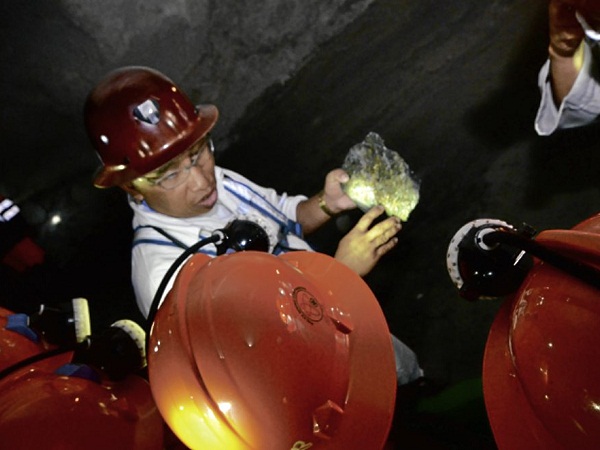
THE PHILEX executive holds up a chunk of ore that contains gold.
One commonly heard criticism of the local mining industry is that it rarely benefits the indigenous people—known by the shorthand: IPs—where the mining firms operate.
In fact, mining firms are often portrayed as marauding entities who come into a community, drain it of its mineral resources, and pack up a few years later, leaving the local populace no better or even worse off than before.
This is, of course, a disputable assertion, but the relationship between Philex Mining Corp. and the communities around it in Benguet are clearly different. And this difference could not be embodied more than it is in the person of the company’s president, Eulalio Austin Jr.
Why? Simply put, Austin is, himself, a member of the Igorot people. And he has risen through the ranks of the country’s largest mining firm to become its chief.
“Where I came from in the Cordilleras, we call ourselves Igorots,” Austin says in an interview with the SundayBiz. “But the Igorots have many tribes under them, we have the Kankanaey, we have the Ifugaos, we have the Ibalois, we have the Kalingas. And I belong to the Kankanaey group.”
Since 1983
Austin—who has been working for Philex since 1983—has known no other profession or employer. Philex, he says, was his first job and his only job because he loves the company and the industry it represents.
But he points out that whatever disadvantage the IPs find themselves in in the mining industry is sometimes self-inflicted.
“It’s not true that IPs are disregarded in mining firms,” he says, responding to the allegation of mining critics. “In fact, they are always the first ones who are consulted when there are new projects.”
He says that at Philex, as well as with most other mining firms, IPs are hired ahead of everyone else whenever job vacancies open up, as part of the industry’s corporate social responsibility programs.
“If there is a local pool available, they are hired,” he says. “This is standard operating procedure. There is a partnership between the firm and the local communities.”
The problem arises, however, when mining firms need to hire workers for jobs with higher educational attainment requirements.
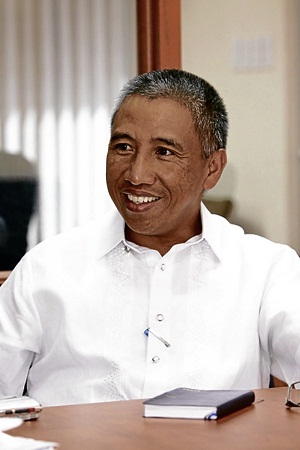
EULALIO Austin Jr.
Austin explains that, while there are no problems hiring IPs for labor-intensive mine operations, issues arise when the job vacancies require candidates to have college degrees.
Many members of IP communities, he says fail to attain higher education because they prefer to start working immediately either as mine sit workers or as part of informal small-scale mining operations.
“In the mining community, the IPs would rather go to small scale mining than work in the mines,” he says. “It’s a culture, especially for Ibalois.”
“There are positions that have educational requirements which the IPs can’t fill, because some of them don’t want to go to school,” he adds.
In his case, however, Austin had always set his sights on higher education because he understood the potential of the mining industry—and the positive and negative effects it could have on the surrounding communities, especially when left to untrained hands.
“For me, I opted to join the mines, because I saw it proper that the mining industry should be controlled,” he says, referring to the small-scale mining operations. “I saw what the IPs were doing.”
And making big sacrifices for the sake of education was something Austin was willing to make.
Early years
He experienced its benefits early on in the household because both his parents were public school teachers. Born in the Mountain Province, he also attended a Catholic school in the area founded by Belgian missionaries who had come to the northern highlands to convert the local tribes to Catholicism.
“I went to a Catholic school for elementary education,” he says. “It was the first Catholic school in the Mountain Province.”
For higher education, he moved to Baguio, which was, then, a seven-hour land trip from his home. In the “big city,” he stayed at a boarding house while he studied to become a mining engineer at the Saint Louis University.
Known locally as “SLU,” the university was, by the time Austin went to college, on its third year of offering a mining engineering course—something that fit perfectly into his dream of working for the mines.
“We were part of the third batch of mining engineers,” he says, noting how life then— even in school—revolved around the mining industry. “In terms of students, most SLU students came from the mines because Benguet Corp. then was a big mining company. Lepanto was also there. SLU became an educational center for the industry.”
From his present perch at the pinnacle of the country’s largest mining firm, Austin shakes his head when hearing criticism about how the industry supposedly neglects the communities it works with.
This, he says, is far from the truth. Austin points out that no less than Baguio City Mayor Mauricio Domogan—himself having worked odd jobs in mining communities in his youth—says that the city was built around the mining industry.
Given how far Austin has risen because of his educational background, he now wants to make sure that other members of the community—IPs, in particular—get to have the same opportunities that were available to him in his youth.
“If you look at the schools in the area and the schools operated by Philex, the latter are so far ahead in terms of standards,” he points out. “Even our elementary school was patterned after the Don Bosco system.”
As has always been its practice, Austin says that Philex pays for the salaries of the schools’ teachers and employees, the maintenance of the buildings, and even the maintenance of lab equipment.
“When computer studies were first introduced as part of the high school curriculum, Philex had it first, ahead of other high schools in Baguio,” he says proudly.
Little wonder then that Austin has never left the company since he joined it.
“I joined Philex in 1983,” he says. “This is my first and only job.”
“They always ask me why I didn’t move out of Philex,” he says. “I say my ambition is to be with my family, to have a good education for my children.”
For a blue-blooded Igorot who has ascended the corporate ladder from the lowest rungs of the country’s largest mining firm with the help of a good education, it is a blessing Austin wishes to share with his fellow IPs.


