





Fair trade pricing key to building Cordillera coffee brand
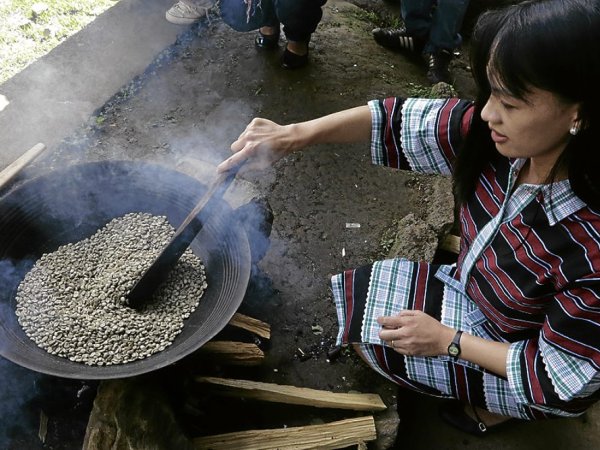
A woman roasts coffee beans at the start of the First Cordillera Coffee Fiesta at the Benguet State University. Photo by EV ESPIRITU/INQUIRER NORTHERN LUZON
LA TRINIDAD, Benguet—Coffee consumption in the country has grown almost as fast as coffee production has fallen in recent years.
But fair trade, at least in upland communities where coffee beans grow best, appears to have remedied that imbalance.
By making sure that coffee farmers get the right share from retail profits for upland Arabica and Kalinga’s Robusta beans, traders believe coffee harvests will grow and fulfill a plan to create a Cordillera Coffee brand.
Fair trade was discussed here last week by Pacita Juan, chair of the Philippine Coffee Board, during the First Coffee Fiesta mounted by local producers.
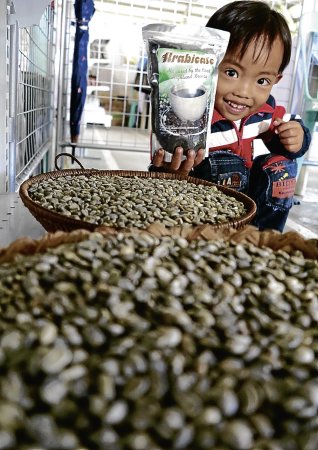
A young man in colorful garb shows off the highlanders’ pride. Photo by EV ESPIRITU/INQUIRER NORTHERN LUZON
Juan says upland farmers need to be treated well in business transactions because to do otherwise would drive them away from sustaining coffee trees “and will plant sayote or something.”
Juan has been collaborating with coffee growers in the Cordillera for years, believing that the mountain region may turn the tide for the local coffee trade.
“We think that the Cordillera is one of the regions that will save the Philippine coffee industry,” she says.
By way of explanation, she offers this anecdote: “In Kalinga [which is a 12-hour travel from Baguio City or an 18-hour drive from Manila], during a visit two weeks ago, we discovered that one town has 4,000 hectares filled with Robusta coffee trees. In Cavite, only 7,000 hectares are planted with Robusta.”
“If we can find all the Kalinga towns with Robusta, homegrown coffee production will improve,” Juan says.
The region is already popular for its high altitude Arabica coffee trees, which are nestled beneath the rainforest canopies of Benguet and the Mt. Province.
However, most of these trees are old and the farmers who tend to them are getting older, Juan says, adding that rejuvenating the trees and replacing the farmers with a younger generation will be necessary before the province and the rest of the Cordillera can strive to become coffee capitals.
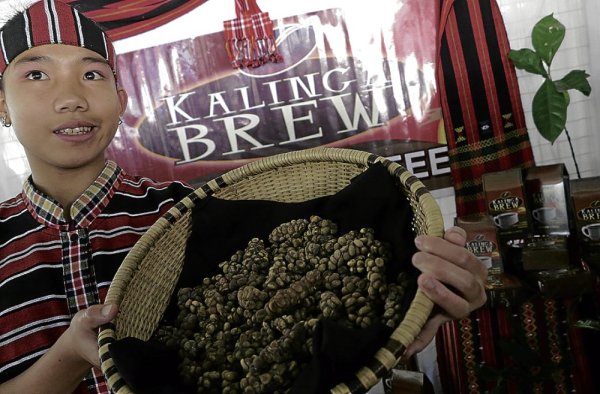
A boy does his bit for the family business. Photo by EV ESPIRITU/INQUIRER NORTHERN LUZON
Making farmers happy by paying them handsomely would also be a good start, she adds.
But farmers have been happy, according to Antuza Refalda, owner of Tabuk City’s Kalinga Brew.
After the present generation of farmers is apprised about the popularity of gourmet or specialty coffee brands, they have increased their take to half of the P250 per can of beans sold in Kalinga these days, Refalda says.
These farmers used to bring home a measly P20 a kilo of coffee beans in the 1970s and 1980s, she says.
But since she started to study the farming conditions of her province in 2000, she realized the potentials of the Robusta coffee which the community used to take for granted.
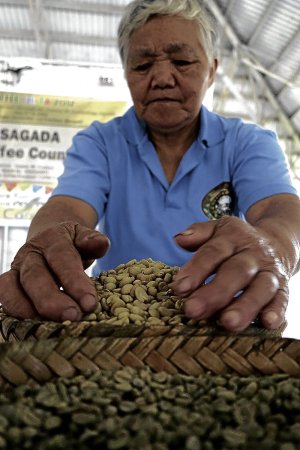
A WOMAN arranges Sagada coffee beans in a basket. Photo by EV ESPIRITU/INQUIRER NORTHERN LUZON
But production has been tepid, Refalda says. And this can only change once farmers learn about fair trade pricing for coffee.
“When I first came for coffee in the Cordillera, [I was told] they (upland farmers) used to harvest 1,000 to 2000 tons [of organic high-altitude Arabica beans),” she says.
“These days, we would be lucky if upland farmers harvest 400 tons,” Refalda adds in Filipino.
According to Juan, the numbers describing the rate of coffee consumption and production have not changed since 2002, when the coffee board was established.
“Consumption has climbed at the same rate as the population, which is about 3 to 5 percent yearly,” Juan says.
But while consumption has breached 65,000 metric tons of coffee per year, coffee production has been nailed down to 25,000 MT “because we keep planting while timber logging and the displacement of trees continue in places where lands are more expensive, [and are now earning revenues as golf courses or resorts],” she explains.


