





Most detailed image of ancient Universe unveiled


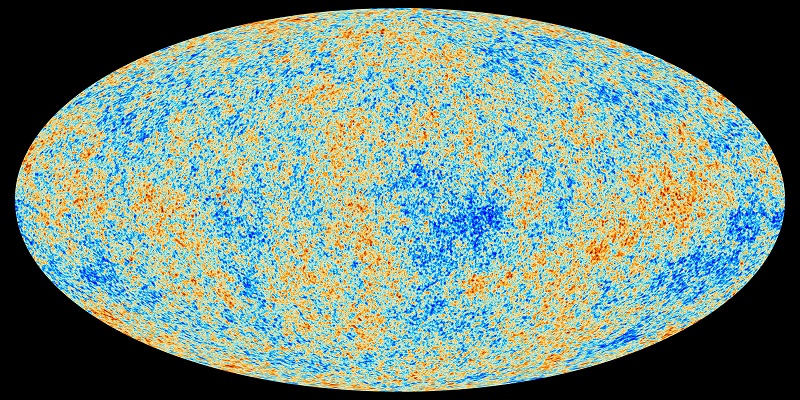
This image released March 21, 2013 by the ESA and Planck Collaboration shows the afterglow of the Big Bang, the cosmic microwave background, as detected by the European Space Agency’s Planck space probe. The radiation was imprinted on the sky when the universe was 370,000 years old. It shows tiny temperature fluctuations that correspond to regions of slightly different densities, representing the seeds of all future structure: the stars and galaxies of today. AP PHOTO/ESA, PLANCK COLLABORATION VIA NASA)
PARIS—A new, detailed map of the most ancient light in the cosmos has revealed our Universe to be about 80 million years older than thought, the European Space Agency (ESA) said Thursday.
The 50-million pixel, all-sky snapshot of radiation left over from the Big Bang was compiled from data gathered by ESA’s Planck satellite, launched four years ago.
“This is a giant leap in our understanding of the origins of the Universe,” the agency’s director general Jean-Jacques Dordain told a press conference to unveil the data in Paris.
“This image is the closest one yet of the Big Bang. You are looking 13.8 billion years ago.”
The oval-shaped map dotted with pixels in blue and brown representing small fluctuations in the temperature of the radiation, adds an edge of precision to many existing cosmological theories— but may shed doubt on others.
It depicts Cosmic Microwave Background (CMB) or relic radiation at a point 380,000 years after the Big Bang, as the newly formed Universe started cooling down.
There were no stars or galaxies then.
The data shows the Universe to be expanding at a slower rate than previously thought, which required adjusting its age to 13.82 billion years.
It also revealed that “normal matter,” which makes up human beings, planets, stars and galaxies, comprised 4.9 percent of the Universe—up from 4.5 percent previously measured.
Dark matter, a mysterious substance thus far only perceived through its gravitational pull, makes up a fifth more than thought—26.8 percent of the Universe in total.
And dark energy, an unexplained force thought responsible for accelerating the expansion of the Universe, accounts for the rest—68.3 percent, down from 72.8 percent.
“We’ve discovered a fundamental truth about the universe,” George Efstathiou, director of the Kavli Institute for Cosmology at the University of Cambridge, told journalists.
“One of our achievements is that there’s less stuff that we don’t understand, by a tiny amount,”—referring to dark energy and dark matter.
“But we still have a major problem in cosmology, because we don’t understand the major constituents of the Universe.”
The Planck data threw up a few questions that the cosmologist said may require “new physics” to explain.
It seems to challenge several theories on “inflation”—a brief period directly after the Big Bang in which the Universe was thought to have expanded at a faster rate than the speed of light.
For the first 380,000 years of its existence, scientists say the Universe was a “hot, dense soup” of protons, electrons and photons at about 2,700 degrees Celsius (4,892 degrees Fahrenheit).
As cooling started, the protons and electrons fused to form hydrogen, and photons or light particles were set free—the “first light” we now see as CMB radiation.
As the Universe expanded, these light waves stretched out into shorter microwave wavelengths, reaching a temperature today of just 2.7 degrees above absolute zero—minus 273.15 C (minus 459.67 F).
“This is the first time that man can look with such clearness at the origin of the Universe, in which we see the impact of forms of matter and energy still unknown today,” cosmologist Carlo Baccigalupi commented in a statement.
Richard Battye of the University of Manchester’s astrophysics center added: “There are… a number of tantalizing hints that there is something missing in our understanding. It will be fun trying to figure out what is going on.”
To take the measurements, the 4.2-meter (13.7-foot) by 4.2-meter Planck satellite’s detectors had to be cooled to near absolute zero. It is capable of measuring temperature variations of a few millionths of a degree.
ESA said anomalies in the data suggested that light rays may not have dispersed in the same way in all directions and may have taken a “more complicated” route through the Universe than previously believed.
The data represents only the satellite’s first 15 months in orbit, and more details will follow, said the agency.—Mariette Le Roux


