Quantcast
Latest Stories

Most Earth species still unknown—Brazil expert


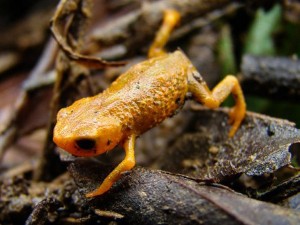
Undated handout image of a new species of three-fingered frog, Brachycephalus tridactylus, at Salto Morato Natural Reserve in Guaraquecaba, southern state of Parana, Brazil. The vast majority of the Earth’s estimated 13 million species are still unknown and to describe them all would take up to 2,000 years, according to a leading Brazilian scientist. AFP PHOTO/ANDRE M. X. LIMA

SAO PAULO—The vast majority of the Earth’s estimated 13 million species are still unknown and to describe them all would take up to 2,000 years, according to a leading Brazilian scientist.

“We estimate that there are a total of around 13 million species (known and unknown) in the world,” Thomas Lewinsohn, a renowned professor of ecology at the State University of Campinas (UNICAMP) in Sao Paulo state.

“Out of these, roughly 1.75 million species, including micro-organisms, plants, insects, bacteria and animals, have been described,” he told AFP in an interview.

And there is actually no consensus on the exact number of species, with experts relying on extrapolation based on known data.

Lewinsohn presented his findings at a forum organized here last week by FAPESP, a local research foundation focusing on Sao Paulo state’s biodiversity.

He said a major problem was a lack of data in countries with the greatest biodiversity such as Brazil, Colombia, Mexico, Indonesia and South Africa.

“Most species have been discovered by amateur taxonomists (scientists who classify organisms according to their physical or cellular characteristics) in Europe,” he noted. “That is not the case in Brazil and countries with high biodiversity where we do not have an army of amateur taxonomists.”

He stressed the importance of understanding the biodiversity of smaller species such as microbes to map out conservation strategies that can preserve the ecosystem.

“You cannot base conservation decisions solely on well-studied groups,” he noted. “If we are concerned about maintaining functioning ecosystems, we must study further the biodiversity of smaller organisms such as insects and microbes.”

Countries such as Brazil need international assistance to build and regularly monitor reference data to “come up with reliable estimates of changes in biodiversity.”

“It requires a different mind-set, a rethink of how money is allocated,” Lewinsohn noted.

Describing all species, he said, might take up to 2,000 years and the cost could range between $25 and 50 billion over 50 years.

Lewinsohn said this compared with the $1.738 trillion the world spent on arms just in 2011 or the $195 billion spent on NASA’s space shuttle program from 1971 to 2011.


Follow Us


Follow us on Facebook Follow on Twitter Follow on Twitter


Recent Stories:

Complete stories on our Digital Edition newsstand for tablets, netbooks and mobile phones; 14-issue free trial. About to step out? Get breaking alerts on your mobile.phone. Text ON INQ BREAKING to 4467, for Globe, Smart and Sun subscribers in the Philippines.

Short URL: http://business.inquirer.net/?p=109769

Tags: Brazil , Science , species

  • Mel Manalo

    they should go to congress with about hundred species of crocodiles

  • bogli_anakdami

    brazilian scientist needs to come to flipland to identify and classify flip gung gongs…

    flip gung gongs have to be recognized as “not fully evolved humans”…


Copyright © 2013, .
To subscribe to the Philippine Daily Inquirer newspaper in the Philippines, call +63 2 896-6000 for Metro Manila and Metro Cebu or email your subscription request here.
Factual errors? Contact the Philippine Daily Inquirer's day desk. Believe this article violates journalistic ethics? Contact the Inquirer's Reader's Advocate. Or write The Readers' Advocate:
c/o Philippine Daily Inquirer Chino Roces Avenue corner Yague and Mascardo Streets, Makati City, Metro Manila, Philippines Or fax nos. +63 2 8974793 to 94
Advertisement

News

  • Estrada picks brains of ex-Cabinet officials for new job as mayor of Manila
  • Police report large shabu haul on Boracay
  • Soldier killed, several others wounded in Ilocos Norte road mishap
  • 18,000 PCOS machines suffered transmission woes, says poll chief
  • Pia Cayetano urges SC to lift suspension of RH Law
  • Sports

  • National U makes Fr. Martin Summer Cup semis
  • Heat beat Pacers in overtime thriller in Game 1
  • Woods: Garcia comment hurtful, time to move on
  • Thoss out; Chot wants Abueva
  • Arellano stuns San Beda, gains q’finals
  • Lifestyle

  • Yellow chicken fast gaining popularity at Wee Nam Kee
  • Chicken mangosteen curry, papaya salad, soft-shell crabs–Thai cuisine reworked for the Filipino palate
  • ‘Turon’ with ‘panocha’
  • Uncommon curry in a Japanese resto
  • Lucban, after Pahiyas: The divine tastes remain
  • Entertainment

  • CA slams Revillame as it affirms show suspension over boy’s lusty dance
  • Ryan Gosling’s violent new crime movie booed at Cannes
  • Soaked, sleepless on Croisette
  • Easier for viewers to relate to
  • Luke Evans: There’s more talent in PH
  • Business

  • Switzerland eyes law on frozen dictator funds
  • Survey shows China manufacturing contracting
  • AirAsia net profit falls nearly 40% in 1st quarter
  • Rinehart loses $7B but still Australia’s richest
  • US stocks fall as market eyes possible Fed retreat
  • Technology

  • Media watchdog criticizes UAE over tweeter’s jail term
  • Twitter tightens security after high-profile breaches
  • Risky behavior starts young on web—survey
  • Office bullying video sparks outcry in Singapore
  • Poll: Teens migrating to Twitter
  • Opinion

  • Editorial cartoon, May 23, 2013
  • False god
  • When neighbors fight
  • Becoming the world’s most bullied
  • Have a heart
  • Global Nation

  • Brown hounded for calling Manila ‘gates of hell’
  • De Lima disputes report NBI team’s Taiwan trip is on hold
  • Comelec, DFA asked to explain how they spent P148M for overseas absentee voting
  • Philippines vows to defend territory against China
  • Grounded ship is PH’s last line of defense vs China
  • Marketplace
    Advertisement
    © Copyright 1997-2013 INQUIRER.net | All Rights Reserved
    skinner left
    skinner right